The Woman Who Saw the Future of Computers
How Ada Lovelace imagined software nearly a century before computers existed.
Ada Lovelace looked beyond the mechanical gears of Charles Babbage’s Analytical Engine and imagined a machine capable of manipulating symbols, composing music and solving problems far beyond arithmetic. Her famous Notes introduced what is…
▶ Watch Documentary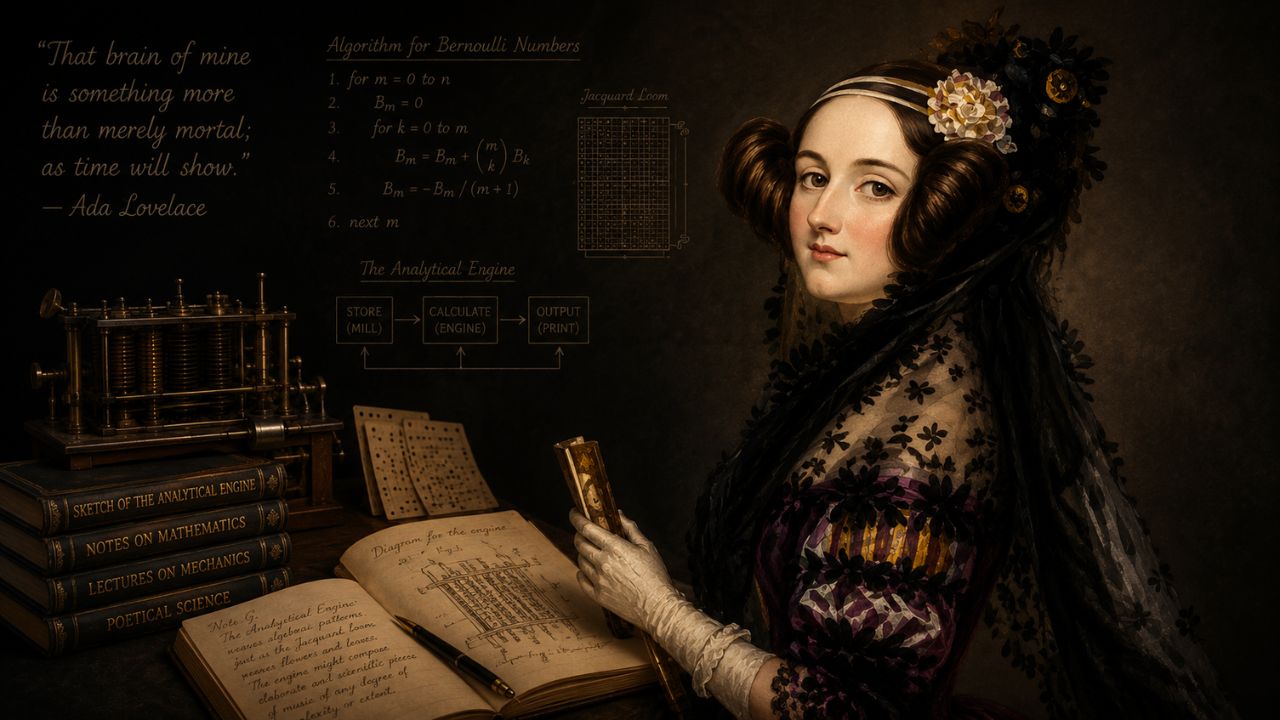
Synopsis
Ada Lovelace looked beyond the mechanical gears of Charles Babbage’s Analytical Engine and imagined a machine capable of manipulating symbols, composing music and solving problems far beyond arithmetic. Her famous Notes introduced what is widely regarded as the world’s first published computer algorithm while presenting concepts that resemble modern software. This documentary explores her remarkable partnership with Babbage, her scientific imagination and the enduring legacy that placed her decades ahead of her time.
Why This Matters
Every computer program written today traces its intellectual roots to ideas Ada Lovelace described in the nineteenth century. She understood that computing machines could process symbols, follow instructions and perform tasks extending far beyond mathematics. Her visionary concepts influenced generations of computer scientists and helped define software as a creative discipline, proving that imagination can predict technologies long before they become reality.
Life & Journey
Born in London
Meets Babbage
Marriage
Menabrea Translation
Algorithm Published
Analytical Notes
Scientific Recognition
Death in London
Notes Republished
Ada Language
Key Takeaways
Ada Lovelace publishes the first computer algorithm while explaining how programmable machines could solve complex tasks.
She foresees computers creating music and manipulating symbols long before electronic computers become reality.
Her visionary ideas establish foundations that inspire generations of programmers and computer scientists worldwide.
More from MigOroEdu
Johannes Kepler
MigOroEdu · 15 min
John B. Goodenough
MigOroEdu · 15 min

Julian Schwinger
MigOroEdu · 15 min
Larry Guth
MigOroEdu · 15 min