The Scientist Who Powered the Wireless World
How John Goodenough created the cathode that made rechargeable lithium-ion batteries practical.
John B. Goodenough reshaped computing and energy storage across a career spanning more than seven decades. Born in Jena in 1922, he studied mathematics at Yale, served as an Army meteorologist and earned a…
▶ Watch Documentary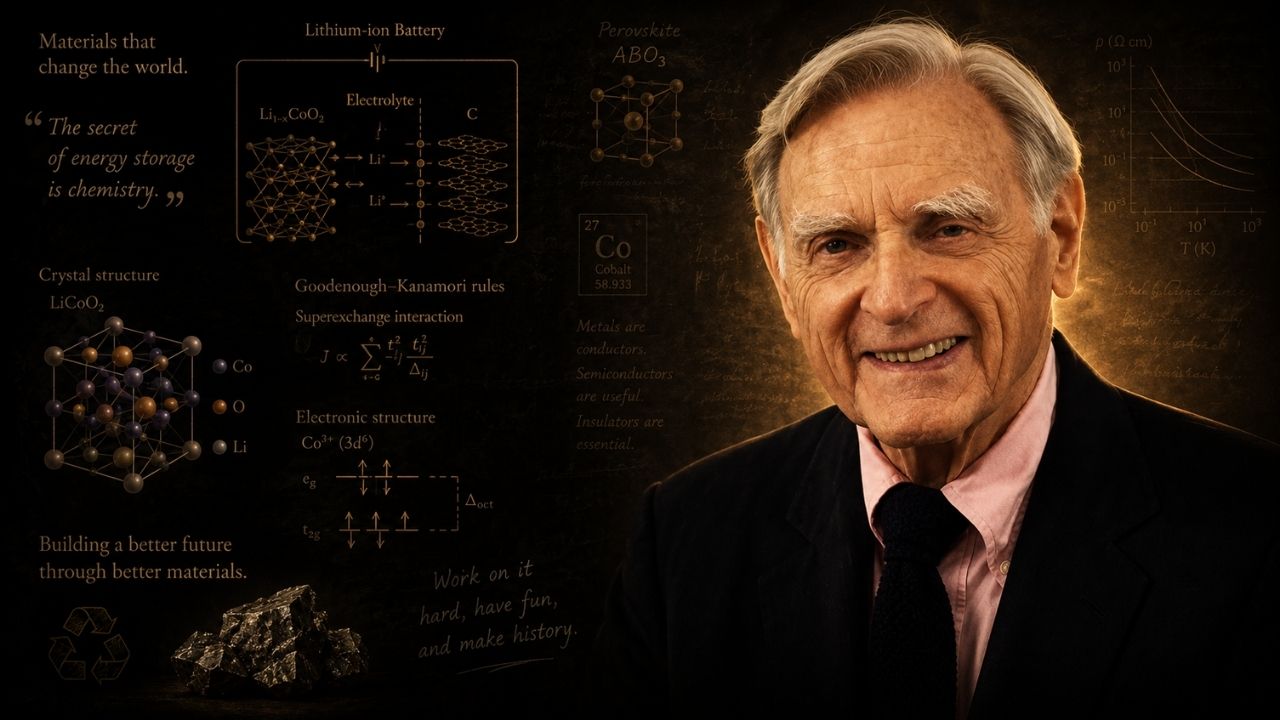
Synopsis
John B. Goodenough reshaped computing and energy storage across a career spanning more than seven decades. Born in Jena in 1922, he studied mathematics at Yale, served as an Army meteorologist and earned a physics doctorate at Chicago in 1952. At MIT Lincoln Laboratory he worked on magnetic memory, and at Oxford he identified lithium cobalt oxide as a high-voltage battery cathode. This documentary follows his move to the University of Texas and the work honored by the 2019 Nobel Prize in Chemistry.
Why This Matters
Rechargeable lithium-ion batteries power phones, laptops, electric vehicles and renewable-energy storage, making Goodenough's cathode one of the enabling technologies of modern life. His story also shows the value of unusually long scientific careers: the crucial battery breakthrough came when he was in his fifties, and he continued researching past one hundred. This documentary connects solid-state chemistry, computing and clean energy while revealing how patient materials research can transform civilization.
Life & Journey
Born in Jena
Yale Mathematics Degree
Army Meteorologist
Chicago Doctorate
Joined Lincoln Laboratory
Joined Oxford
Lithium Cathode Developed
Joined UT Austin
Nobel Prize
Death in Austin
More from MigOroEdu
Luis Caffarelli
MigOroEdu · 15 min
Alain Aspect
MigOroEdu · 15 min
László Lovász
MigOroEdu · 15 min
Osamu Shimomura
MigOroEdu · 15 min