The 200-Year-Old Equation We Still Can't Prove Is Safe
It predicts fluids everywhere—but nobody has proved that every smooth 3D flow stays smooth forever.
For two centuries, the Navier–Stokes equations have described the motion of viscous fluids and powered models of weather, aircraft and flowing blood. Yet mathematics still cannot prove that every smooth three-dimensional flow governed by…
▶ Watch Documentary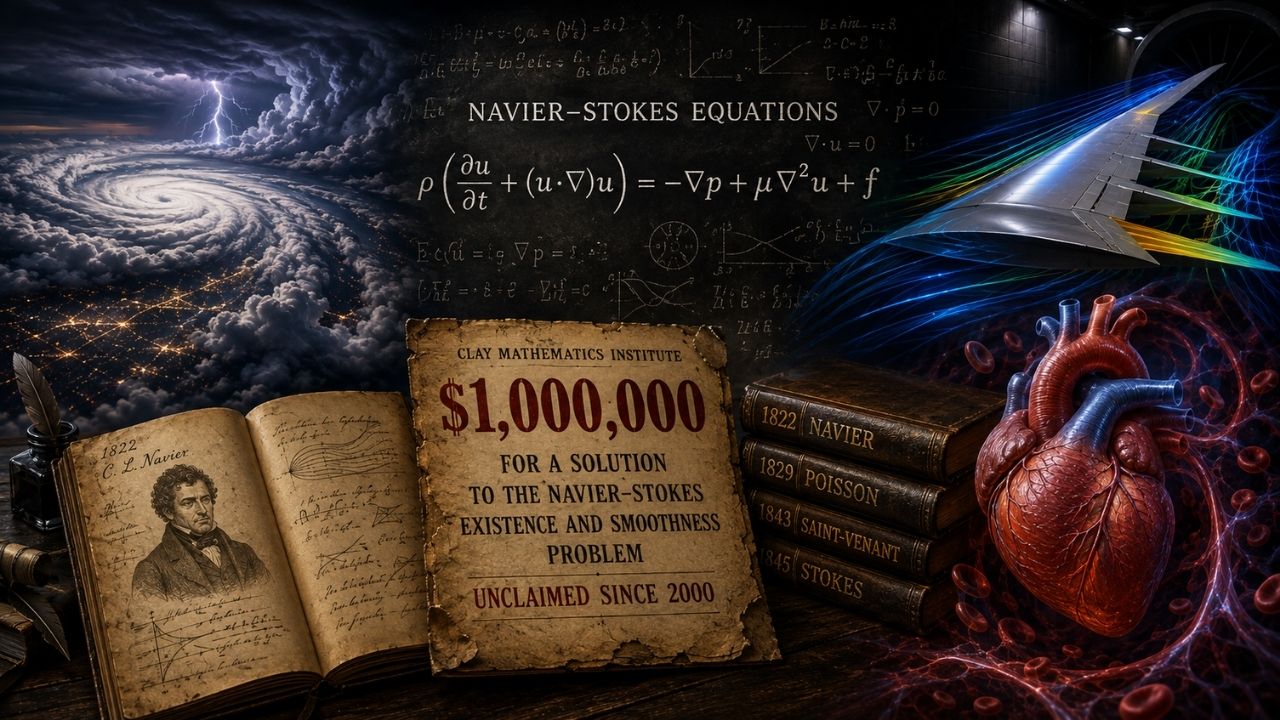
Synopsis
For two centuries, the Navier–Stokes equations have described the motion of viscous fluids and powered models of weather, aircraft and flowing blood. Yet mathematics still cannot prove that every smooth three-dimensional flow governed by the incompressible equations stays smooth forever. From Navier’s 1822 derivation and Stokes’s reformulation to Leray’s weak solutions, the Caffarelli–Kohn–Nirenberg theorem and the Clay Millennium Prize, this documentary follows the unresolved possibility of blow-up.
Why This Matters
Few scientific stories expose the difference between practical reliability and mathematical proof as clearly as Navier–Stokes. The equations work across engineering and physics, yet their three-dimensional global regularity remains unresolved. Following Navier, Stokes, Leray and later breakthroughs, the documentary shows what mathematicians have proved, what a singularity would mean, and why a million-dollar problem can survive underneath everyday simulations without making those simulations meaningless or unsafe.
Life & Journey
Euler Formulates Ideal Fluid Equations
Navier Introduces Viscous Fluid Equation
Poisson Develops Fluid Equations
Saint-Venant Advances Viscous Theory
Stokes Gives General Viscous Formulation
Leray Proves Global Weak Solutions
Caffarelli-Kohn-Nirenberg Partial Regularity
Beale-Kato-Majda Vorticity Criterion
Clay Announces Millennium Prize Problems
Navier-Stokes Problem Remains Unsolved
More from MigOroEdu
A Problem So Simple a Child Can Understand It — And Nobody Can Solve It
MigOroEdu · 15 min

The Pattern That Was True a Trillion Times — And Still False
MigOroEdu · 15 min
The Shape That Can Fill Space — Without Ever Repeating It
MigOroEdu · 15 min