The Mathematician Who Changed the Rules
How László Lovász connected graphs, topology, information and algorithms to reshape discrete mathematics.
László Lovász transformed discrete mathematics by repeatedly solving problems with ideas that seemed to belong somewhere else. He used topology to prove Kneser’s conjecture, introduced the theta function in 1979 to determine the Shannon…
▶ Watch Documentary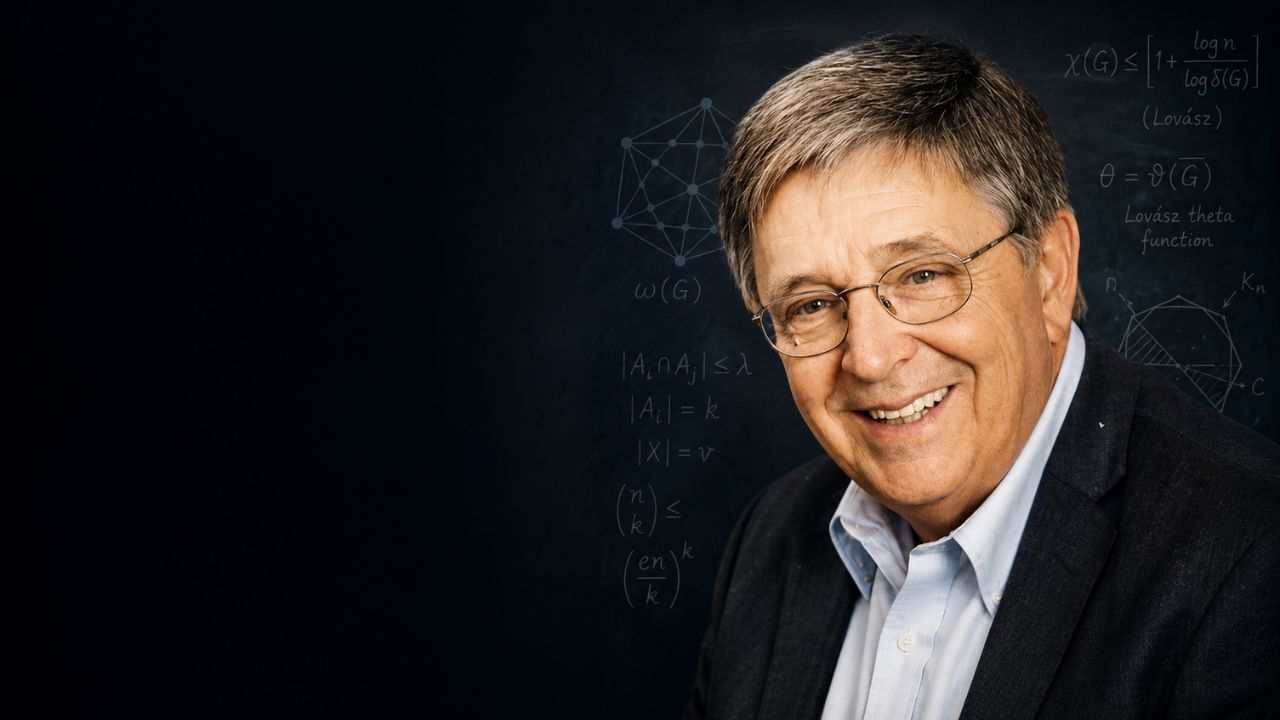
Synopsis
László Lovász transformed discrete mathematics by repeatedly solving problems with ideas that seemed to belong somewhere else. He used topology to prove Kneser’s conjecture, introduced the theta function in 1979 to determine the Shannon capacity of the pentagon, and co-created the LLL lattice-reduction algorithm in 1982. His work connected graph theory with information, optimization, number theory and computer science. After decades of research and mathematical leadership, he shared the 2021 Abel Prize with Avi.
Why This Matters
Lovász's career reveals how breakthroughs often happen when mathematical boundaries are ignored. A topology theorem solved a combinatorics problem; vectors cracked Shannon's stubborn pentagon; and an algorithm created for polynomial factorization became a standard weapon in number theory and cryptanalysis. His ideas helped build the bridge between discrete mathematics and theoretical computer science. Following those connections shows why Lovász became one of the central architects of modern combinatorics and.
Life & Journey
Born in Budapest
Doctorate at ELTE
Joins Szeged Faculty
Proves Kneser Conjecture
Theta Function Published
LLL Algorithm Published
Joins Yale University
Joins Microsoft Research
Leads Hungarian Academy
Abel Prize
More from MigOroEdu
A Problem So Simple a Child Can Understand It — And Nobody Can Solve It
MigOroEdu · 15 min

The Pattern That Was True a Trillion Times — And Still False
MigOroEdu · 15 min

The Shape That Can Fill Space — Without Ever Repeating It
MigOroEdu · 15 min