The Shape That Can Fill Space — Without Ever Repeating It
How can a finite set of local rules force an infinite pattern that is never allowed to repeat?
A handful of shapes should eventually repeat—or so intuition suggests. Aperiodic tilings prove otherwise. Beginning with Hao Wang’s colored-edge squares, the story follows Robert Berger’s undecidability breakthrough, the race to shrink aperiodic tile sets,…
▶ Watch Documentary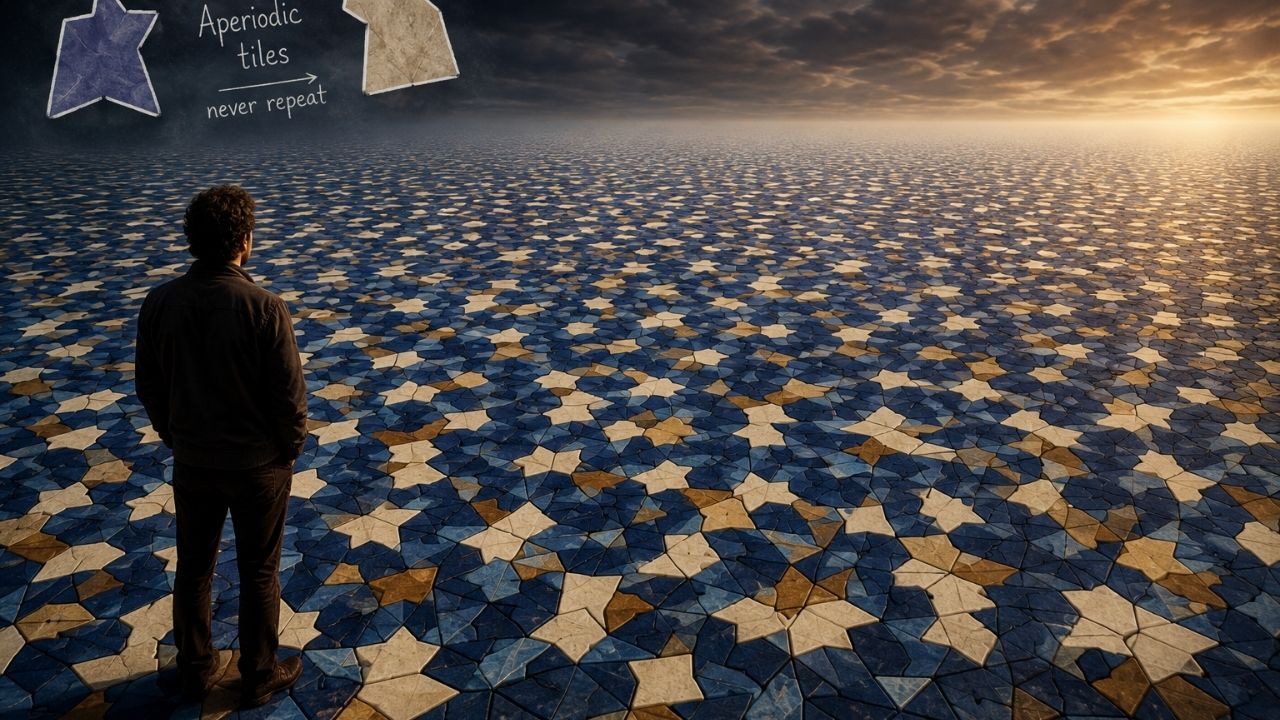
Synopsis
A handful of shapes should eventually repeat—or so intuition suggests. Aperiodic tilings prove otherwise. Beginning with Hao Wang’s colored-edge squares, the story follows Robert Berger’s undecidability breakthrough, the race to shrink aperiodic tile sets, Roger Penrose’s two-tile patterns, Dan Shechtman’s quasicrystals and the 2023 discovery of the hat and Spectre monotiles. The result is a journey from logic to geometry to matter, showing how local rules can force infinite order without periodic repetition.
Why This Matters
Aperiodic tilings turn a visual puzzle into a deep lesson about computation, symmetry and emergence. This documentary explains why Berger's tiles shattered Wang's expectation, how Penrose reduced the phenomenon to two celebrated shapes, why five-fold order mattered to the discovery of quasicrystals, and how David Smith and collaborators finally reached a single aperiodic tile. It reveals an unsettling mathematical idea: finite local instructions can generate endless global structure without ever settling into a.
Life & Journey
Hao Wang Poses Periodic Tiling Conjecture
Berger Publishes Undecidability Breakthrough
Robinson Builds Six-Tile Aperiodic Set
Penrose Develops Two-Tile Aperiodic System
Shechtman Observes Quasicrystal Diffraction
Shechtman Receives Nobel Prize in Chemistry
Jeandel and Rao Find Minimal 11 Wang Tiles
David Smith Discovers the Hat Tile
Hat Aperiodic Monotile Paper Released
Spectre Solves Chiral Monotile Challenge
More from MigOroEdu
A Problem So Simple a Child Can Understand It — And Nobody Can Solve It
MigOroEdu · 15 min

The Pattern That Was True a Trillion Times — And Still False
MigOroEdu · 15 min
The 200-Year-Old Equation We Still Can’t Prove Is Safe
MigOroEdu · 15 min