This Liquid Should Have Settled Down. Instead It Started Organizing Itself
A reaction once dismissed as impossible revealed how lifeless chemistry can keep time, form waves and organize itself.
A liquid sits untouched in a beaker, yet its color repeatedly flips as if an internal clock were running. Boris Belousov’s mid-century observation seemed so incompatible with prevailing chemical intuition that editors rejected it.…
▶ Watch Documentary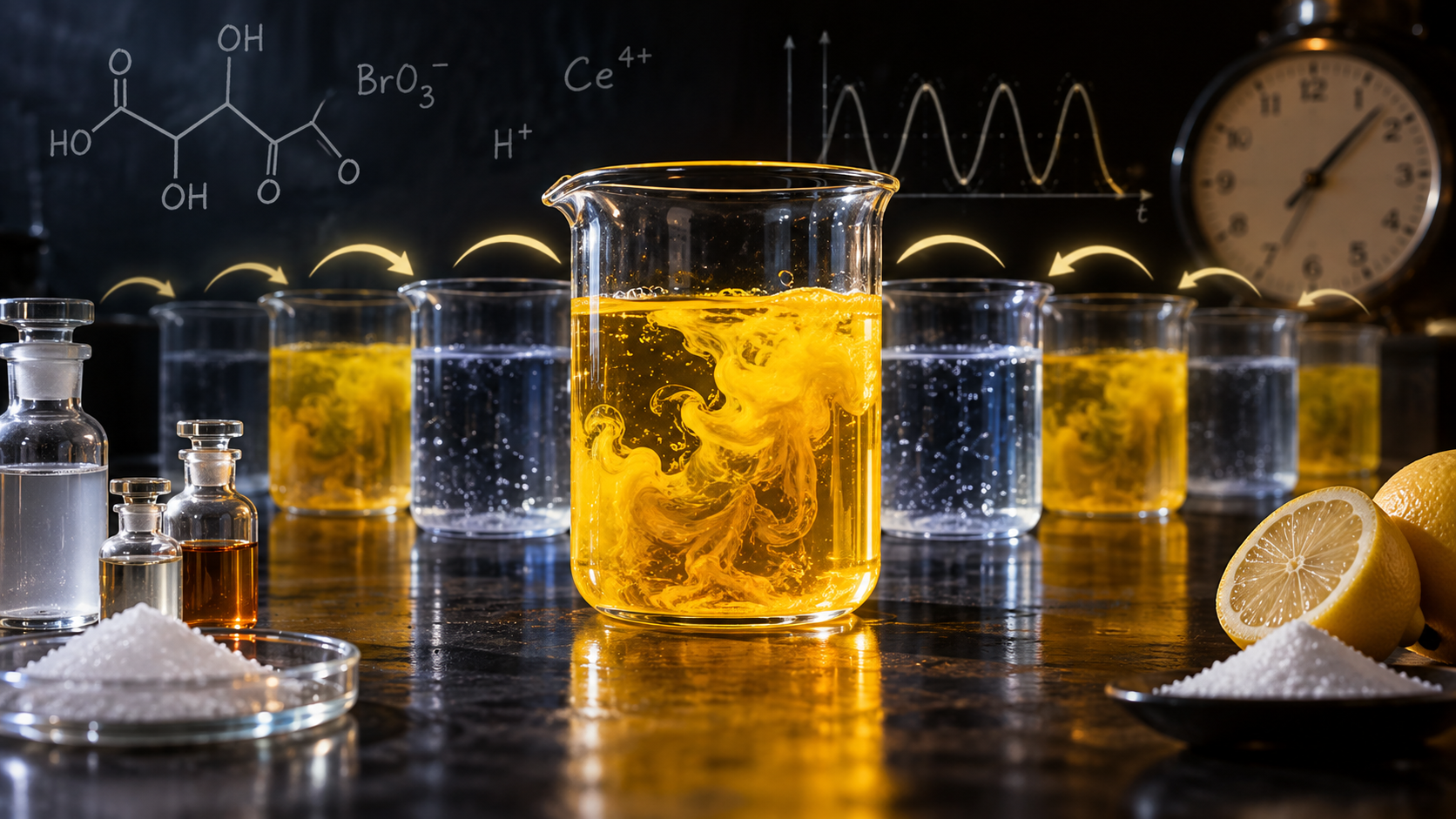
Synopsis
A liquid sits untouched in a beaker, yet its color repeatedly flips as if an internal clock were running. Boris Belousov’s mid-century observation seemed so incompatible with prevailing chemical intuition that editors rejected it. Anatoly Zhabotinsky later developed the phenomenon, and the FKN mechanism exposed the feedback behind its oscillations. In thin layers the chemistry produces target waves and spirals, making the BZ reaction a vivid laboratory example of nonlinear dynamics, reaction-diffusion and.
Why This Matters
The Belousov-Zhabotinsky reaction turns an abstract idea into something you can watch: chemistry creating rhythm and geometry without an external controller. Its history moves from Belousov's rejected result to Zhabotinsky's experiments, the Field-Körös-Noyes mechanism, rotating spiral waves and Prigogine's broader framework of dissipative structures. The same mathematics of excitable media helps researchers reason about wave propagation in biological systems, including cardiac tissue, while showing why thermodynamics.
Life & Journey
Boris Belousov Observes Sustained Chemical Oscillations in a Bromate System
Belousov's Work Appears in Soviet Medical Conference Proceedings
Anatoly Zhabotinsky Begins Investigating the Oscillating Reaction
Zhabotinsky Publishes Experimental Work on the Oscillating System
Zhabotinsky and Zaikin Report Propagating Waves and Spatial Patterns
Field, Körös and Noyes Develop the FKN Mechanistic Framework
Field and Noyes Introduce the Simplified Oregonator Model
Ilya Prigogine Receives the Nobel Prize for Non-Equilibrium Thermodynamics
BZ Spirals Become Major Experimental Models for Excitable-Media Dynamics
Modern Imaging and Modeling Continue Quantifying BZ Waves, Spirals and Nonlinear Kinetics
More from MigOroEdu
Osamu Shimomura
MigOroEdu · 15 min
John B. Goodenough
MigOroEdu · 15 min
Otto Hahn
MigOroEdu · 15 min
Irène Joliot-Curie
MigOroEdu · 15 min