A Problem So Simple a Child Can Understand It — And Nobody Can Solve It
Every tested number falls into the same tiny loop. Mathematics still cannot prove that every number must.
Start with any positive integer. If it is even, divide by two; if it is odd, triple it and add one. The Collatz conjecture says every starting value eventually reaches 1, yet no proof…
▶ Watch Documentary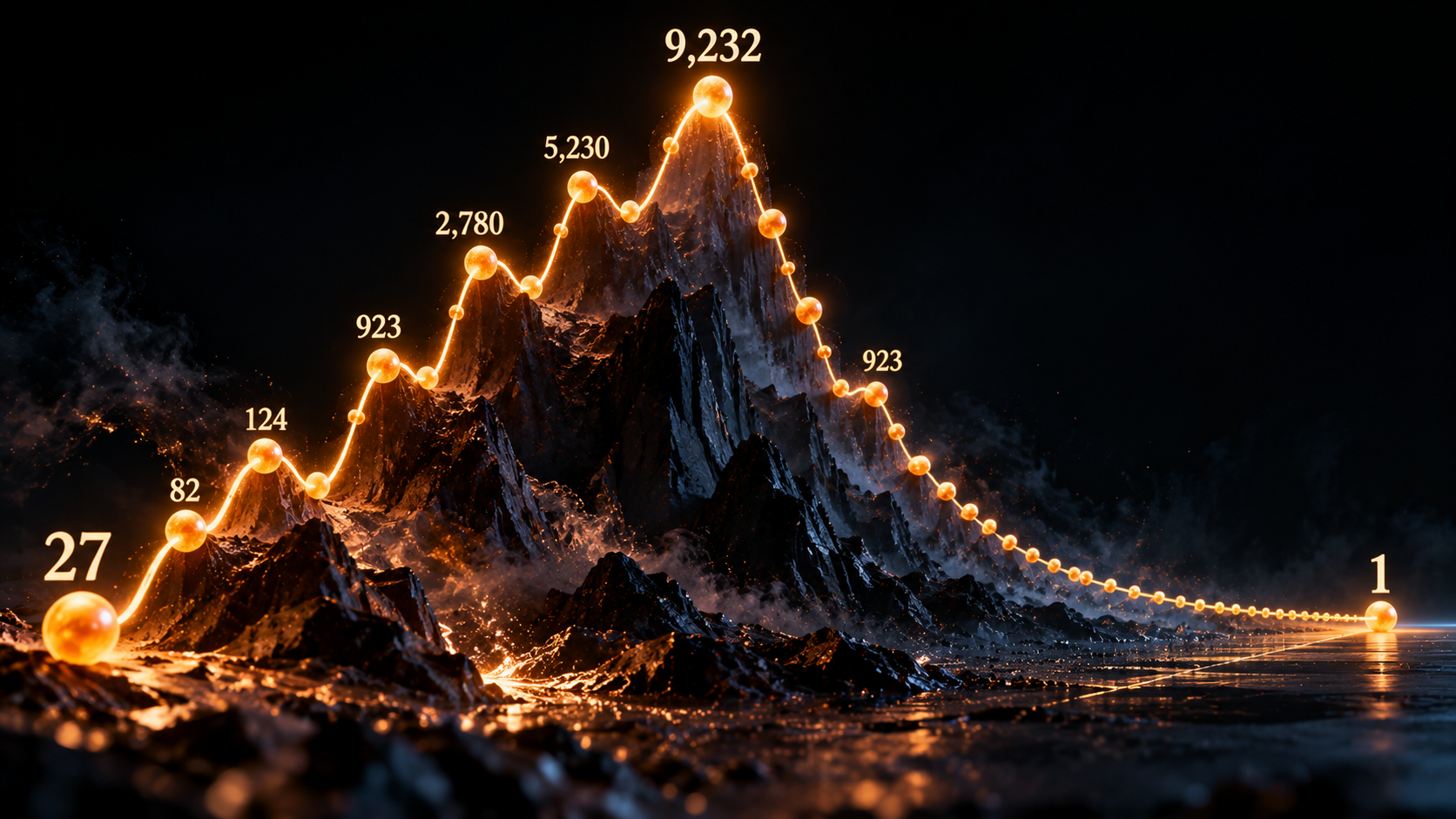
Synopsis
Start with any positive integer. If it is even, divide by two; if it is odd, triple it and add one. The Collatz conjecture says every starting value eventually reaches 1, yet no proof is known. This documentary follows the strange orbit of 27, explains why average downward drift is not enough, traces decades of computer verification, and reaches Terence Tao’s 2019 breakthrough. It then asks the deeper question: can a rule simple enough for a child conceal computational behavior that mathematics cannot easily control?
Why This Matters
The Collatz conjecture is a perfect demonstration of the difference between overwhelming evidence and mathematical proof. Billions upon billions of tested cases can all reach 1 without settling what happens across infinitely many integers. The story moves from Lothar Collatz's tiny rule to giant supercomputer searches, Terence Tao's almost-all theorem and John Conway's work on generalized Collatz systems. It shows how elementary arithmetic can generate unpredictable behavior and why infinity defeats even extraordinary.
Life & Journey
Lothar Collatz Circulates the 3n+1 Problem
Conway Shows Undecidability in Generalized Collatz-Type Systems
Early Computer Verification Reaches Roughly 2^25
Lagarias Surveys Deep Obstacles and Bounds on Possible Cycles
Leavens and Vermeulen Push Verification Beyond 2^45
Lagarias and Weiss Develop Stochastic Models of 3n+1 Behavior
Distributed Verification Reaches 87 × 2^60
Terence Tao Proves Almost All Orbits Attain Almost Bounded Values
Bařina's Project Verifies Convergence Below 2^68
Distributed Supercomputer Search Extends Verification to 2^71
More from MigOroEdu

The Pattern That Was True a Trillion Times — And Still False
MigOroEdu · 15 min

The Shape That Can Fill Space — Without Ever Repeating It
MigOroEdu · 15 min
The 200-Year-Old Equation We Still Can’t Prove Is Safe
MigOroEdu · 15 min