The Problem Mathematicians Abandoned — Until an Outsider Wouldn't Let It Go
A seven-point graph held the lower bound for decades—until Aubrey de Grey used it to prove the infinite plane needs at least five colors.
How many colors are needed to color every point of an infinite plane if points exactly one unit apart can never match? For decades the Hadwiger–Nelson problem was trapped between four and seven. Then…
▶ Watch Documentary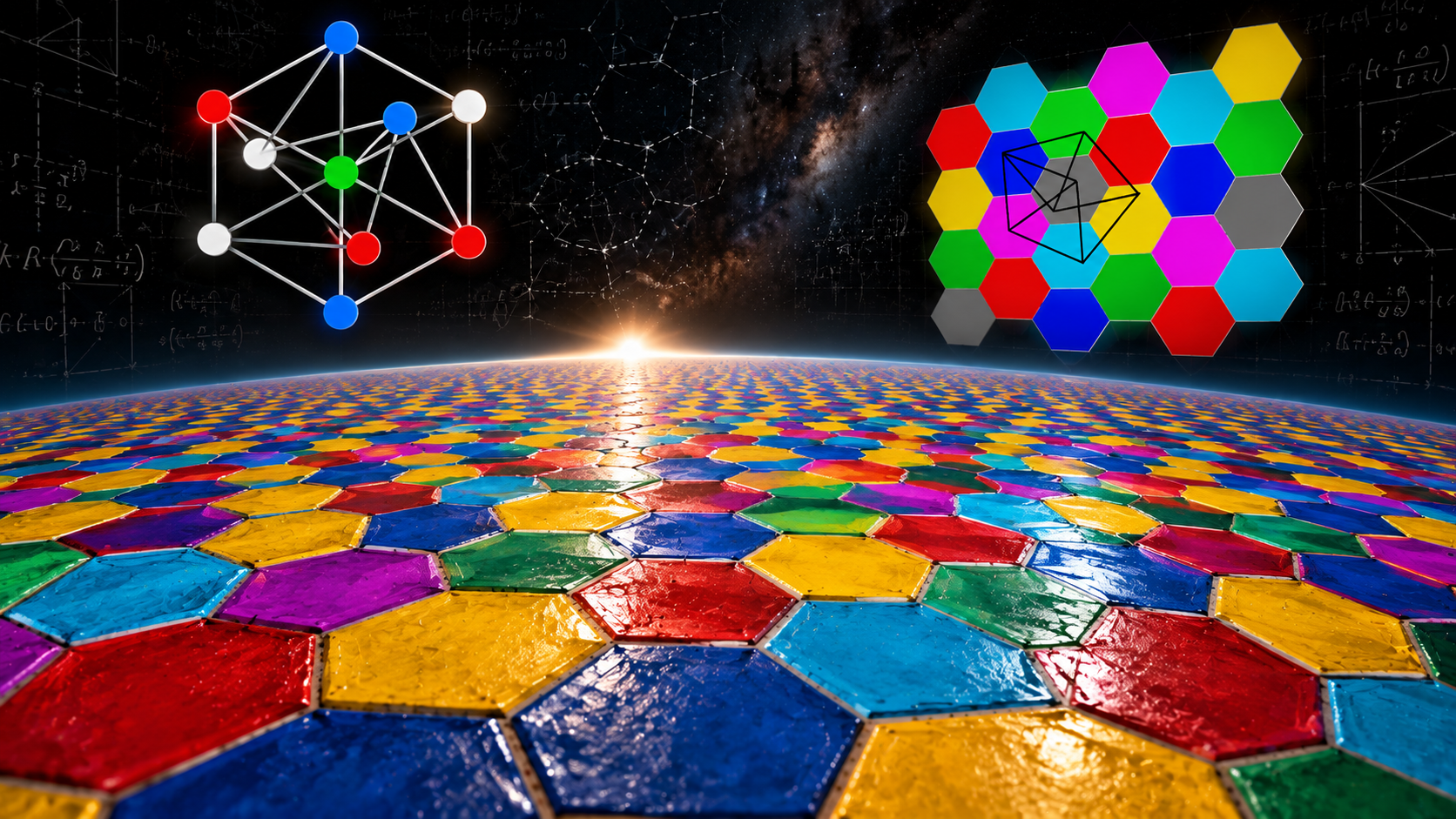
Synopsis
How many colors are needed to color every point of an infinite plane if points exactly one unit apart can never match? For decades the Hadwiger–Nelson problem was trapped between four and seven. Then in 2018 biogerontologist Aubrey de Grey combined copies of the familiar Moser spindle into a 1,581-vertex unit-distance graph that could not be colored with four colors. The breakthrough raised the lower bound to five and triggered an open collaborative search that eventually reduced the construction to 509 vertices.
Why This Matters
The Hadwiger–Nelson problem turns a rule simple enough for a child into one of graph theory's most stubborn open questions. Its history shows how finite graphs can constrain the coloring of an infinite plane, why the seven-vertex Moser spindle mattered for decades, and how Aubrey de Grey unexpectedly broke a 68-year stalemate in 2018. The story then follows SAT solvers, Polymath collaboration and Jaan Parts's 509-vertex graph—while the final answer stubbornly remains one of only three possibilities: five, six or seven.
Life & Journey
Hadwiger Publishes Related Plane-Covering Result
Edward Nelson Raises the Plane-Coloring Problem
John Isbell Gives the Seven-Color Upper Bound
Martin Gardner Brings the Problem into Print
Moser Spindle Establishes a Four-Color Lower Bound
Aubrey de Grey Proves the Lower Bound Is Five
Exoo and Ismailescu Produce an Independent Proof
Polymath and Heule Rapidly Shrink 5-Chromatic Graphs
Jaan Parts Reaches a 509-Vertex Construction
Problem Remains Open with Bounds Five to Seven
More from MigOroEdu
A Problem So Simple a Child Can Understand It — And Nobody Can Solve It
MigOroEdu · 15 min

The Pattern That Was True a Trillion Times — And Still False
MigOroEdu · 15 min
The Shape That Can Fill Space — Without Ever Repeating It
MigOroEdu · 15 min
The 200-Year-Old Equation We Still Can’t Prove Is Safe
MigOroEdu · 15 min