The Mathematician Who Found Where Navier–Stokes Could Break
How Luis Caffarelli transformed regularity theory, constrained possible fluid singularities and won the 2023 Abel Prize.
Luis Caffarelli transformed the study of partial differential equations by learning how to distinguish smooth behavior from singularity. After moving from Buenos Aires to Minnesota, a problem from Hans Lewy led him to free…
▶ Watch Documentary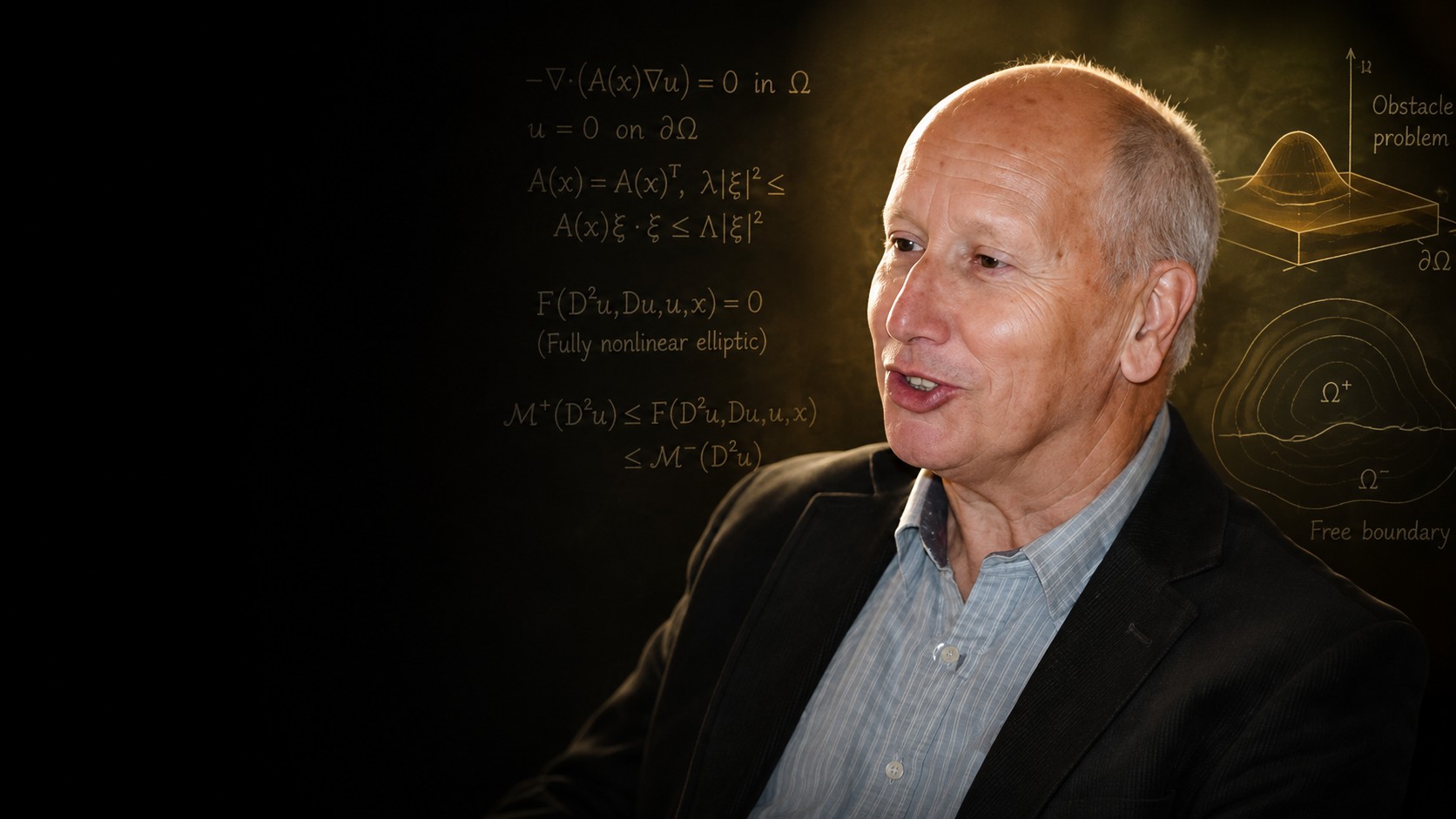
Synopsis
Luis Caffarelli transformed the study of partial differential equations by learning how to distinguish smooth behavior from singularity. After moving from Buenos Aires to Minnesota, a problem from Hans Lewy led him to free boundaries and his landmark 1977 regularity theorem. At Courant he joined Robert Kohn and Louis Nirenberg to prove the 1982 CKN theorem, sharply restricting possible Navier–Stokes singularities. Later breakthroughs on nonlinear equations and Monge–Ampère theory led to the 2023 Abel Prize.
Why This Matters
Caffarelli's mathematics tackles a deceptively simple question: when equations model the physical world, how can we know their solutions stay well behaved? His work on obstacle problems showed how apparently irregular boundaries can become smooth, while the CKN theorem proved that any singularities in suitable Navier–Stokes solutions must be exceptionally small. He never solved the Millennium Problem itself; instead, he built some of the strongest tools for approaching it and reshaped regularity theory across nonlinear.
Life & Journey
Born in Buenos Aires
University of Buenos Aires PhD
Moves to Minnesota
Free-Boundary Breakthrough
Joins Courant Institute
CKN Navier–Stokes Theorem
Bôcher Memorial Prize
Monge–Ampère Advances Begin
Wolf Prize
Abel Prize
More from MigOroEdu
A Problem So Simple a Child Can Understand It — And Nobody Can Solve It
MigOroEdu · 15 min
The Pattern That Was True a Trillion Times — And Still False
MigOroEdu · 15 min
The Shape That Can Fill Space — Without Ever Repeating It
MigOroEdu · 15 min