The Scientist Who Found Biology's Green Light
How a search for the secret of glowing jellyfish produced one of the most powerful tools in modern biology.
Osamu Shimomura spent decades asking why living organisms glow. After surviving the Nagasaki atomic bombing, he entered chemistry and mastered the purification of a luminous compound from Cypridina. At Princeton he turned to Aequorea…
▶ Watch Documentary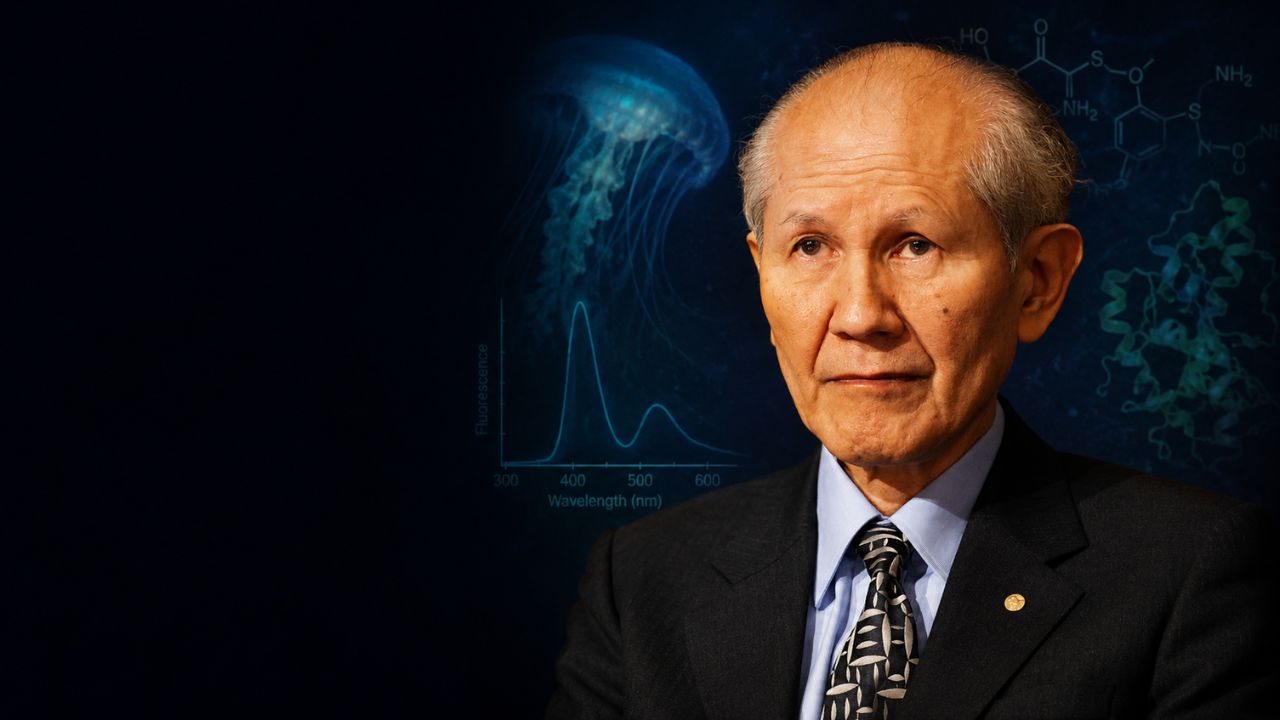
Synopsis
Osamu Shimomura spent decades asking why living organisms glow. After surviving the Nagasaki atomic bombing, he entered chemistry and mastered the purification of a luminous compound from Cypridina. At Princeton he turned to Aequorea jellyfish, isolating aequorin and green fluorescent protein in work published in 1962. He later identified GFP’s chromophore in 1979. Decades afterward, GFP became a genetic beacon for watching processes inside living cells, bringing Shimomura a share of the 2008 Nobel Prize in Chemistry.
Why This Matters
GFP is now so fundamental to biology that its origin can seem inevitable, but Shimomura discovered it while pursuing a completely different question: how a jellyfish produces light. His painstaking biochemical work revealed aequorin, GFP and the unusual self-contained chemistry behind GFP's fluorescence. Only decades later did other scientists turn the protein into a genetic marker. The story shows how curiosity-driven research can remain apparently impractical for years before becoming a technology that transforms an.
Life & Journey
Born in Fukuchiyama
Survives Nagasaki Bombing
Joins Nagoya Laboratory
Cypridina Luciferin Crystals
Joins Princeton Research
Aequorin and GFP Published
GFP Chromophore Identified
Joins Marine Biological Lab
GFP Expressed in Cells
Nobel Prize Chemistry