The Undergraduate Who Solved a Problem Mathematicians Couldn't
John Pardon's path from Gromov's knot-distortion problem to foundational work in symplectic geometry and a Fields Medal.
John Pardon emerged as an exceptional geometer while still an undergraduate at Princeton, when he solved Mikhail Gromov’s 1983 knot-distortion problem after an early approach failed. His 2011 Annals paper proved that the distortion…
▶ Watch Documentary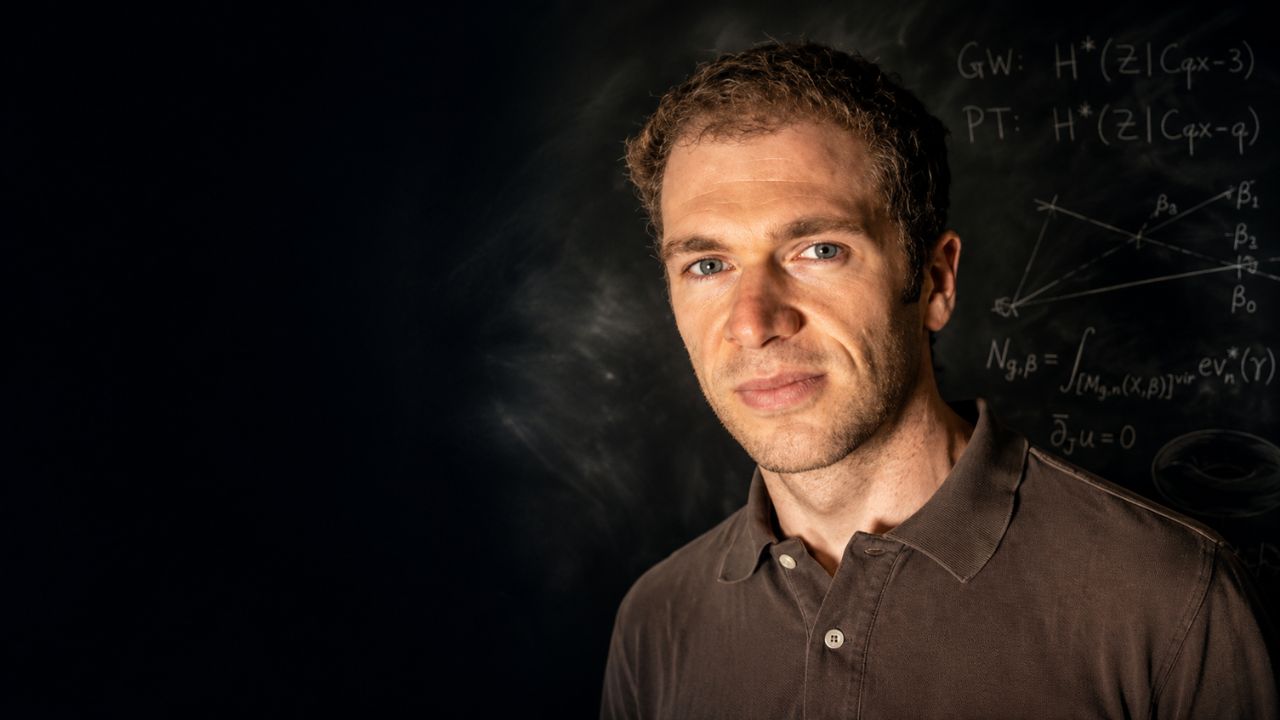
Synopsis
John Pardon emerged as an exceptional geometer while still an undergraduate at Princeton, when he solved Mikhail Gromov’s 1983 knot-distortion problem after an early approach failed. His 2011 Annals paper proved that the distortion of certain torus knots grows without bound. After a Stanford Ph.D. with Yakov Eliashberg, Pardon developed influential work on three-manifold group actions, virtual fundamental cycles, Fukaya categories and holomorphic curves. In 2026, those achievements brought him a Fields Medal.
Why This Matters
Pardon's career shows how a single stubborn problem can open into an entire mathematical program. His undergraduate solution to Gromov's knot-distortion question combined geometry, topology and analysis, but it was only the beginning. He later attacked foundational problems in symplectic geometry, where defining virtual fundamental cycles and counting holomorphic curves requires extraordinary technical precision. His 2026 Fields Medal recognizes both this depth and an unusual ability to move between distant areas of.
Life & Journey
Intel Talent Finalist
Solves Gromov Problem
Annals Paper Published
Princeton Valedictorian
Morgan Prize
Hilbert-Smith Breakthrough
Stanford PhD
Princeton Professor
Joins Simons Center
Fields Medal
More from MigOroEdu

A Problem So Simple a Child Can Understand It — And Nobody Can Solve It
MigOroEdu · 15 min

The Pattern That Was True a Trillion Times — And Still False
MigOroEdu · 15 min

The Shape That Can Fill Space — Without Ever Repeating It
MigOroEdu · 15 min