The Mathematician Who Solved the Four-Dimensional Poincaré Problem
How Michael Freedman classified four-manifolds and later turned topology toward quantum computing.
Michael Freedman achieved one of topology’s great breakthroughs by proving the four-dimensional topological Poincaré conjecture and classifying simply connected topological four-manifolds. Born in Los Angeles in 1951, he entered Princeton graduate school unusually young…
▶ Watch Documentary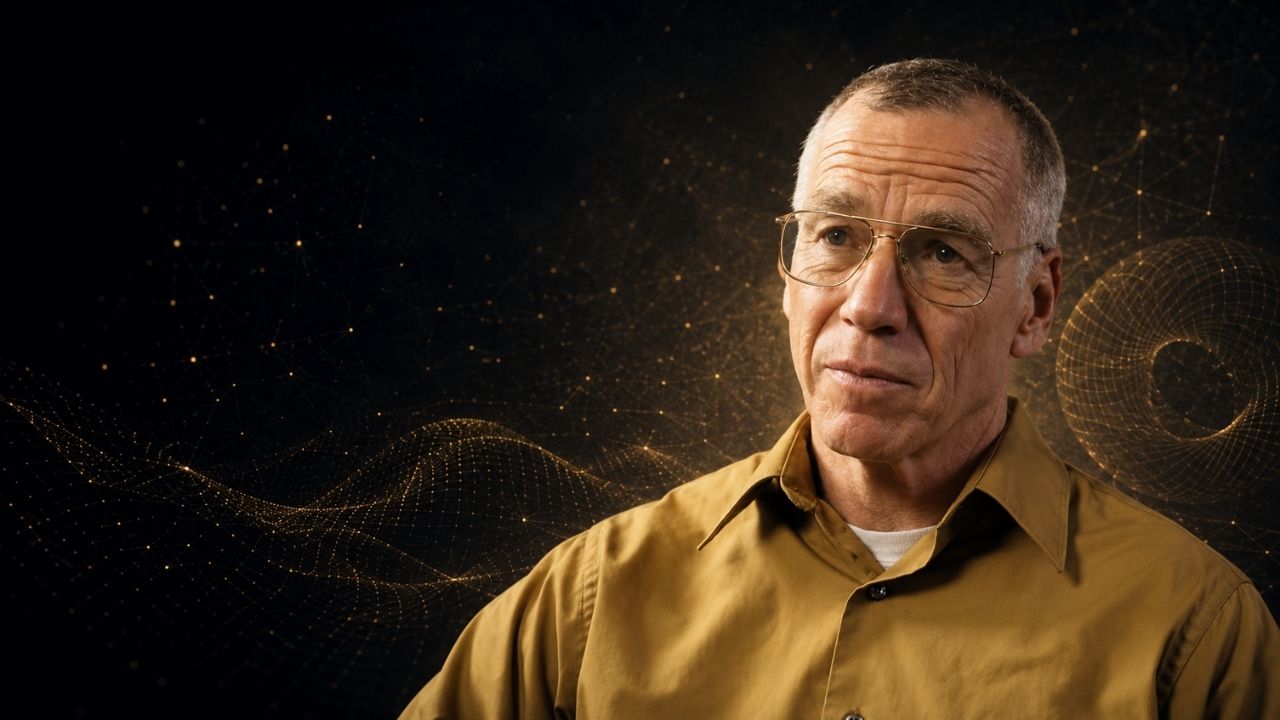
Synopsis
Michael Freedman achieved one of topology’s great breakthroughs by proving the four-dimensional topological Poincaré conjecture and classifying simply connected topological four-manifolds. Born in Los Angeles in 1951, he entered Princeton graduate school unusually young and earned his doctorate in 1973. At UC San Diego he developed the work that brought the 1986 Fields Medal. This documentary follows the strange world of four dimensions and his later move to Microsoft Station Q and topological quantum computing.
Why This Matters
Dimension four is the boundary where topology becomes uniquely wild: spaces can be topologically equivalent yet possess radically different smooth structures. Freedman's classification revealed this extraordinary landscape and solved a central Poincaré problem. His later work connected topology with quantum information, proposing that exotic particle behavior could protect calculations from errors. This documentary links a pure mathematical triumph with one of technology's most ambitious goals: building a reliable.
Life & Journey
Born in Los Angeles
Entered Princeton
Princeton Doctorate
Joined IAS
Joined UC San Diego
Four-Manifold Classification
MacArthur Fellowship
Fields Medal
National Science Medal
Joined Microsoft
More from MigOroEdu
The Shape That Can Fill Space — Without Ever Repeating It
MigOroEdu · 15 min
The 200-Year-Old Equation We Still Can’t Prove Is Safe
MigOroEdu · 15 min
Luis Caffarelli
MigOroEdu · 15 min
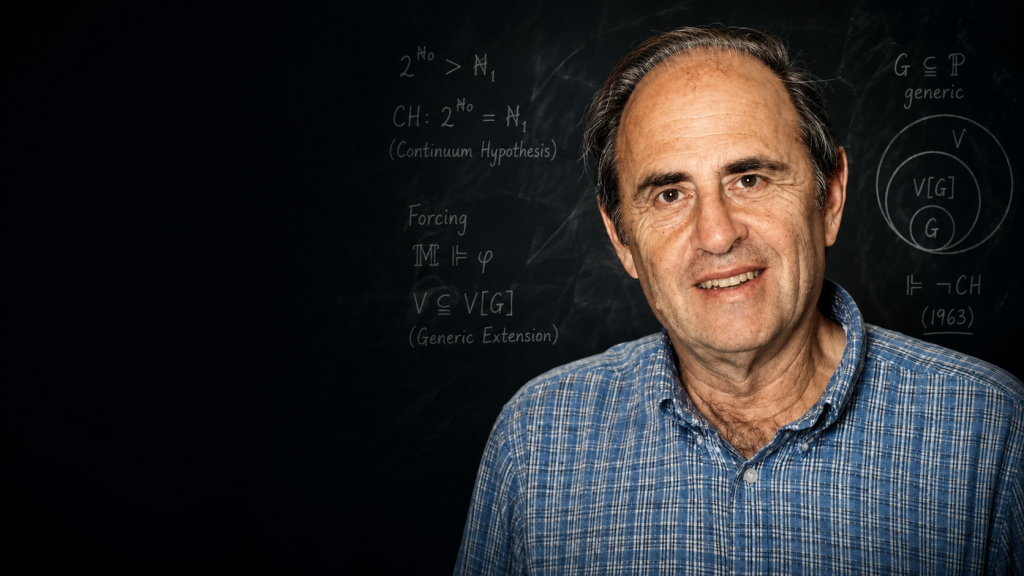
Paul Cohen
MigOroEdu · 15 min