The Experimenter Who Made Chemistry a Science
How Robert Boyle used air pumps, measurement and skepticism to transform the study of matter.
Robert Boyle helped create modern experimental chemistry by insisting that claims about matter must be tested through observation, instruments and repeatable trials. With Robert Hooke’s air pump, he investigated vacuum, pressure and respiration, leading…
▶ Watch Documentary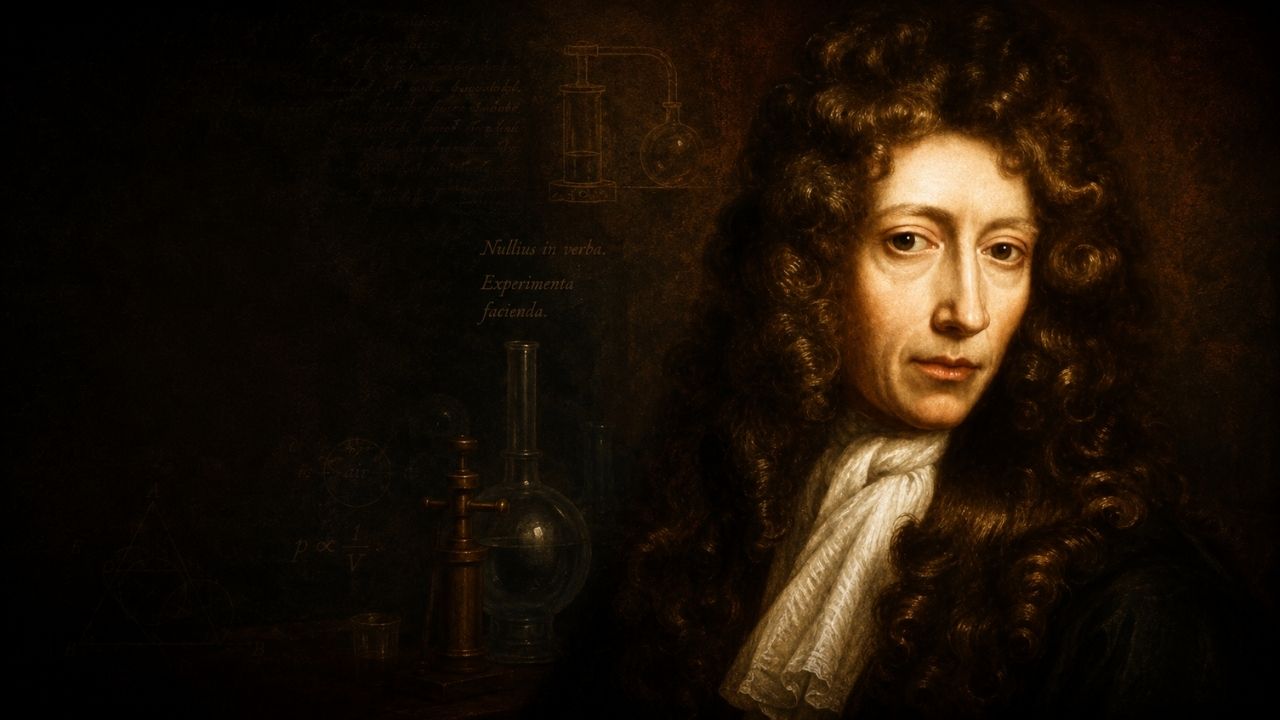
Synopsis
Robert Boyle helped create modern experimental chemistry by insisting that claims about matter must be tested through observation, instruments and repeatable trials. With Robert Hooke’s air pump, he investigated vacuum, pressure and respiration, leading to the inverse pressure-volume relationship called Boyle’s law. His 1661 book The Sceptical Chymist challenged inherited theories of elements and matter. This documentary follows Boyle from Ireland to Oxford and London, tracing how experiment replaced authority in the.
Why This Matters
Boyle's law remains essential in chemistry, physics, engineering, medicine and diving, while his experimental standards helped define what modern science expects from evidence. The Sceptical Chymist questioned ancient elemental theories and encouraged chemistry to become an independent discipline. His collaborations with Hooke and role in the Royal Society also reveal how instruments and scientific communities drive discovery. Boyle's story explains why measurement, skepticism and reproducibility became pillars of.
Life & Journey
Born in Lismore
Entered Eton
European Education
Returned to England
Moved to Oxford
Air Pump Completed
New Experiments Published
Sceptical Chymist
Boyle's Law Published
Death in London
More from MigOroEdu
Osamu Shimomura
MigOroEdu · 15 min
Johannes Kepler
MigOroEdu · 15 min
John B. Goodenough
MigOroEdu · 15 min
Julian Schwinger
MigOroEdu · 15 min