
ARCHIVE > TRAILBLAZING WOMEN
maryam mirzakhani
Mapping Curved Universes
Early Life and Childhood
A Tehran Childhood
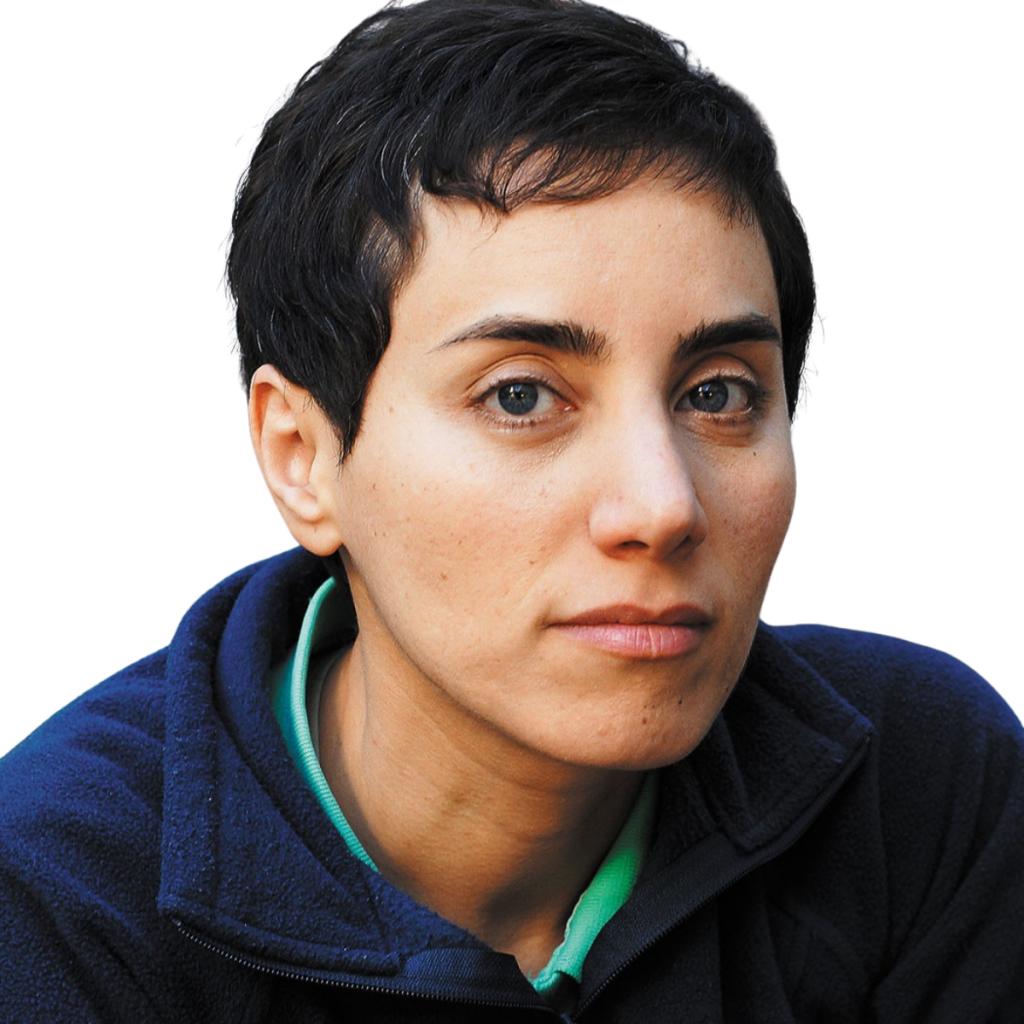
Maryam Mirzakhani was born on 12 May 1977 in Tehran, Iran, to Ahmad Mirzakhani, an electrical engineer, and Zahra Haghighi. She grew up with three siblings during one of Iran’s most turbulent periods — the Iran-Iraq War of the 1980s — which made everyday life difficult but did not diminish her family’s emphasis on education and personal growth. Her parents were, by her own account, deeply supportive and valued meaningful work above outward achievement. It was her older brother who first ignited her interest in science by sharing what he learned at school, an early mentorship she would recall with warmth throughout her life.
As a young girl, Mirzakhani’s dreams were literary rather than mathematical. She aspired to become a novelist and spent hours immersed in books. Mathematics entered her life less as a childhood passion and more as a gradually revealed calling — one that would eventually consume and transform her entirely. This origin story, of a future mathematical giant who once wanted to write fiction, became part of the legend that surrounded her after she rose to global prominence.
Education and Mathematical Awakening
Farzanegan School and the Olympiad Years
Mirzakhani attended Tehran Farzanegan School, an elite institution administered by Iran’s National Organization for Development of Exceptional Talents (NODET). It was here that her mathematical abilities came into sharp focus. The school’s principal was remembered by Mirzakhani as having an exceptionally positive and upbeat mindset — someone who encouraged girls to aim for firsts and push past institutional hesitation. This culture of high expectation proved formative.
At the urging of a supportive teacher, Mirzakhani joined the Iranian mathematical olympiad team. In 1994, she competed in Hong Kong at the International Mathematical Olympiad (IMO), where she scored 41 out of 42 and won a gold medal — becoming the first Iranian woman ever to do so. She returned in 1995 to the IMO in Toronto, Canada, achieving the rare feat of a perfect score of 42 out of 42 and winning a second consecutive gold medal, making her the first Iranian to achieve full marks at the competition. These early triumphs allowed her to bypass Iran’s national college entrance examination entirely.
Sharif University of Technology
From 1995 to 1999, Mirzakhani studied at Sharif University of Technology in Tehran,
earning a B.Sc. in Mathematics. She developed a simpler proof of a theorem of Schur,
attracting early recognition from the American Mathematical Society.
Harvard University and Curtis McMullen
At Harvard, under Fields Medalist Curtis McMullen, Mirzakhani earned her PhD in 2004
with a dissertation on simple geodesics and moduli space volumes — results so significant
they were published across three top mathematics journals.
Mathematical Research and Major Contributions
Hyperbolic Surfaces and Simple Closed Geodesics
The centrepiece of Mirzakhani’s doctoral work was the counting of simple closed geodesics on hyperbolic surfaces — one of the deep, classical problems in the geometry of surfaces. A geodesic is the shortest path between two points on a curved surface; on a sphere, great circles serve as geodesics. On hyperbolic surfaces — surfaces of constant negative curvature — the geometry behaves very differently from the flat Euclidean plane. In hyperbolic space, infinitely many lines can pass through a given point parallel to another line, and the angles of a triangle sum to less than 180 degrees.
Mirzakhani proved that the number of simple closed geodesics of length at most L on a hyperbolic surface of genus g grows asymptotically as a polynomial in L of degree 6g-6. This was a breakthrough: earlier results had treated all geodesics (including those that self-intersect), but simple closed geodesics — those that do not cross themselves — are far harder to count and behave completely differently. Her method was to relate this counting problem to volume calculations on the moduli space of Riemann surfaces, an inspired bridge between two areas that had previously seemed unrelated.
#{simple closed geodesics of length <= L} ~ C(S) * L^(6g-6)Along the way, her technique yielded a new and completely unexpected proof of the Witten conjecture, a fundamental formula in mathematical physics relating the intersection theory of moduli spaces of curves. This conjecture had been proved previously by Kontsevich (for which he received a Fields Medal), but Mirzakhani’s proof was entirely independent and illuminated the conjecture from a radically different angle.
Weil-Petersson Volumes and Moduli Spaces
A major strand of Mirzakhani’s work concerned the computation of Weil-Petersson volumes of moduli spaces of bordered Riemann surfaces. The moduli space of a surface is the space of all possible geometric structures (hyperbolic metrics) that the surface can be given, and the Weil-Petersson metric gives this space its own geometry. Mirzakhani developed a recursive technique — now called Mirzakhani’s recursion — for computing these volumes, unifying a broad class of geometric questions about surfaces under a single elegant framework. Her formulas showed that the volume polynomials encode deep information about the topology of the moduli space.
The Magic Wand Theorem
Mirzakhani’s later career produced perhaps her most celebrated result: the theorem now known as the ‘magic wand theorem,’ proved jointly with Alex Eskin and with contributions from Amir Mohammadi. The theorem concerns the dynamics of the SL(2, R) action on the moduli space of translation surfaces — a setting that generalises the study of billiard trajectories in polygons. The key result is that any orbit closure under this action is an algebraic submanifold: it is not an irregular fractal or a complicated set but a smooth, structured algebraic variety. This rigidity result was the analogue, in the very different world of moduli spaces, of the celebrated theorems of Marina Ratner concerning unipotent flows on homogeneous spaces.
The theorem’s proof was monumental — described by Fields Medalist Terence Tao as ‘a titanic work’ — and it unified disparate areas of mathematics including ergodic theory, algebraic geometry, and Teichmuller dynamics. Its applications span the study of billiard paths in rational polygons, the geometry of flat surfaces, and fundamental questions about the structure of moduli spaces. The theorem has continued to inspire research well beyond Mirzakhani’s own lifetime.
Closure of any GL+(2,R)-orbit in moduli space = affine invariant submanifold
Thurston Earthquake Flow
Mirzakhani proved the ergodicity and mixing of Thurston’s earthquake flow on
Teichmuller space, resolving a long-open problem using a novel bridge between the
holomorphic and symplectic aspects of the theory.
Academic Career
Clay Mathematics Institute and Princeton
After her 2004 PhD, Mirzakhani became a Clay Mathematics Institute Research Fellow
and assistant professor at Princeton University (2004-2008), launching her independent
research on Teichmuller dynamics and moduli spaces.
Stanford University
In 2008, aged 31, Mirzakhani was appointed full professor at Stanford. She was named
a Simons Investigator in 2013 and elected to the US National Academy of Sciences in
2016, becoming the first Iranian woman to receive that honour.
Working Style
Mirzakhani worked visually, covering the floor with large sheets of paper covered in
geometric doodles and diagrams. Her daughter once described her work as “paintings.”
This tactile, exploratory approach to geometry was central to how she conceived problems.
The Fields Medal — A Historic First
The Award and Its Significance
On 13 August 2014, at the opening ceremony of the International Congress of Mathematicians in Seoul, South Korea, Maryam Mirzakhani was awarded the Fields Medal — the most prestigious prize in mathematics, awarded every four years to two to four mathematicians under the age of 40. In receiving the medal, she became the first woman in history to win the award since its establishment in 1936, and also the first Iranian. The award citation recognised her ‘outstanding contributions to the dynamics and geometry of Riemann surfaces and their moduli spaces.’
The Fields Medal committee’s extended citation described how Mirzakhani’s work had made ‘stunning advances in the theory of Riemann surfaces and their moduli spaces, and led the way to new frontiers in this area.’ It noted that her insights had integrated methods from algebraic geometry, topology, and probability theory — synthesising a range of deep mathematical traditions into a unified and fertile new approach. The news spread rapidly around the world and was celebrated not only in the mathematical community but as a cultural milestone: a woman from Iran breaking a 78-year-old barrier in one of the most demanding intellectual disciplines.
Reaction and Global Impact
Her award was celebrated globally and resonated with particular cultural significance
in Iran. Iranian President Hassan Rouhani shared her photograph publicly. Her achievement
inspired a new generation of women and girls to pursue careers in mathematics worldwide.
Personal Life
Marriage and Family
Mirzakhani was married to Jan Vondrák, a Czech-American theoretical computer scientist.
They had one daughter, Anahita. Colleagues described Mirzakhani as humble, generous,
and deeply supportive of other mathematicians throughout her career.
Diagnosis and Illness
Even before receiving the Fields Medal in 2014, Mirzakhani had been diagnosed with
breast cancer. She continued mathematical research through her illness with extraordinary
resolve, remaining productive until the cancer spread to her bones and liver.
Death and Legacy
Death
Mirzakhani died on 14 July 2017 in Palo Alto, California, aged 40, following the
spread of breast cancer to her liver and bones. She was honoured three days later at
the opening of the 58th International Mathematical Olympiad in Rio de Janeiro.
Awards and Honours in Her Memory
The Maryam Mirzakhani New Frontiers Prize ($50,000, annual) was established in 2019
for early-career women mathematicians. Asteroid 321357 Mirzakhani was named in her
honour. The University of Oxford launched Mirzakhani Scholarships in 2022 (funded
at £2.48 million) to support female doctoral students in mathematics.
Continuing Mathematical Influence
Her techniques — including Mirzakhani’s recursion and the magic wand theorem —
continue to generate new mathematics. The 12 May Initiative, coordinated by multiple
women-in-mathematics organisations worldwide, celebrates women in mathematics annually
on the anniversary of her birth.
Sources & Extra Reading
Primary Research Papers
- Mirzakhani, M. (2007). Simple geodesics and Weil-Petersson volumes of moduli spaces of bordered Riemann surfaces. Inventiones Mathematicae, 167, 179-222.
- Mirzakhani, M. (2007). Weil-Petersson volumes and intersection theory on the moduli space of curves. Journal of the American Mathematical Society, 20(1), 1-23.
- Mirzakhani, M. (2008). Growth of the number of simple closed geodesics on hyperbolic surfaces. Annals of Mathematics, 168, 97-125.
- Eskin, A., Mirzakhani, M., & Mohammadi, A. (2015). Isolation, equidistribution, and orbit closures for the SL(2,R) action on moduli space. Annals of Mathematics, 182(2), 673-721. arXiv:1305.3015
Obituaries and Scientific Profiles
- Rafi, K. (2017). Maryam Mirzakhani (1977-2017). Nature, 549, 32. https://doi.org/10.1038/549032a
- Bridson, M. (2017, July 19). Maryam Mirzakhani obituary. The Guardian.
- Tao, T. (2017, July 15). Maryam Mirzakhani. What’s New (blog). https://terrytao.wordpress.com/2017/07/15/maryam-mirzakhani/
- Zorich, A. (2015). The work of Maryam Mirzakhani. AMS Notices, 62, 1345-1349.
Reference and Institutional Sources
- Britannica: https://www.britannica.com/biography/Maryam-Mirzakhani
- MacTutor History of Mathematics: https://mathshistory.st-andrews.ac.uk/Biographies/Mirzakhani/
- Agnes Scott College Biographies of Women Mathematicians: https://www.agnesscott.edu/lriddle/women/mirzakhani.htm
- IMA (Institute of Mathematics and its Applications): https://ima.org.uk/7329/maryam-mirzakhani-work/
- Quanta Magazine profile: https://www.quantamagazine.org/maryam-mirzakhani-is-first-woman-fields-medalist-20140812/
Frequently Asked Questions
Q1: What is Maryam Mirzakhani most famous for?
Mirzakhani is most famous for becoming the first woman and first Iranian to win the Fields Medal, awarded in 2014 at the International Congress of Mathematicians in Seoul. She received the award for her groundbreaking contributions to the dynamics and geometry of Riemann surfaces and their moduli spaces, including counting simple closed geodesics on hyperbolic surfaces and proving the magic wand theorem with Alex Eskin.
Q2: What is the Fields Medal, and how does it compare to the Nobel Prize?
The Fields Medal is awarded every four years to between two and four mathematicians under the age of 40, recognising both outstanding achievement and future promise. It is widely regarded as the highest honour in mathematics. There is no Nobel Prize in Mathematics, so the Fields Medal occupies an equivalent position in the field. It was established in 1936 and Mirzakhani became its 52nd recipient — and its first female recipient — in 2014.
Q3: What is a geodesic, and why did Mirzakhani’s work on them matter?
A geodesic is the shortest path between two points on a curved surface — the generalisation of a straight line to curved geometry. On a sphere, geodesics are great circles. On a hyperbolic surface (which has constant negative curvature), geodesics behave very differently. Mirzakhani studied simple closed geodesics — those that return to their starting point without crossing themselves — and proved a precise formula for how many exist on surfaces of a given shape. This solved a long-standing open problem and connected it unexpectedly to the geometry of moduli spaces.
Q4: What is the magic wand theorem?
The magic wand theorem, proved by Mirzakhani and Alex Eskin (with contributions from Amir Mohammadi), states that the closure of any orbit of the group SL(2, R) acting on the moduli space of translation surfaces is an algebraic submanifold — a smooth, structured algebraic object rather than an irregular fractal. The theorem is the analogue, in the highly complex world of moduli spaces, of Marina Ratner’s rigidity theorems for homogeneous spaces. It has wide applications in the study of billiard trajectories, flat surfaces, and the geometry of abstract spaces.
Q5: Did Mirzakhani face barriers as a woman in mathematics?
Yes, and she overcame several. As a child, a teacher in middle school told her she had no particular talent for mathematics. Later, she navigated the structural barriers that have historically limited women’s participation in the highest levels of academic mathematics — including the Fields Medal’s 78-year all-male record. After winning the medal, she faced the pressure of intense public attention while simultaneously raising a young daughter and managing a cancer diagnosis, yet she continued to produce significant mathematical work. She was a quiet but powerful advocate for the inclusion of women in mathematics.
Q6: What honours exist today in Mirzakhani’s name?
Several major honours carry her name. The Maryam Mirzakhani New Frontiers Prize, established in 2019 by the Breakthrough Prize Foundation, provides $50,000 annually to outstanding early-career women mathematicians. The University of Oxford’s Maryam Mirzakhani Scholarships (launched 2022) support female doctoral students in mathematics. Asteroid 321357 is named Mirzakhani. The 12 May Initiative (on the anniversary of her birthday) coordinates global celebrations of women in mathematics. Streets and buildings in Oxford, Berlin, and Tehran also bear her name.
Q7: What was her birth date, and why do some sources give different dates?
The most reliable sources, including MacTutor History of Mathematics and her Wikipedia article, give her birth date as 12 May 1977. Some sources, including Britannica, have listed 3 May 1977. The discrepancy likely arises from differences between the Iranian solar calendar and the Gregorian calendar, or from transcription errors in early publications. The 12 May date is considered the correct one, and is the date adopted by the 12 May Initiative created in her honour.