The Universe That Computed Space — But Forgot Gravity
Entanglement could build the geometry. But to make matter bend it, physicists needed a stranger quantum ingredient: magic.
Physicists have learned to encode toy models of space using quantum entanglement and error-correcting codes. But the cleanest early codes had a fatal flaw: their geometry stayed fixed when matter changed, so they could…
▶ Watch Documentary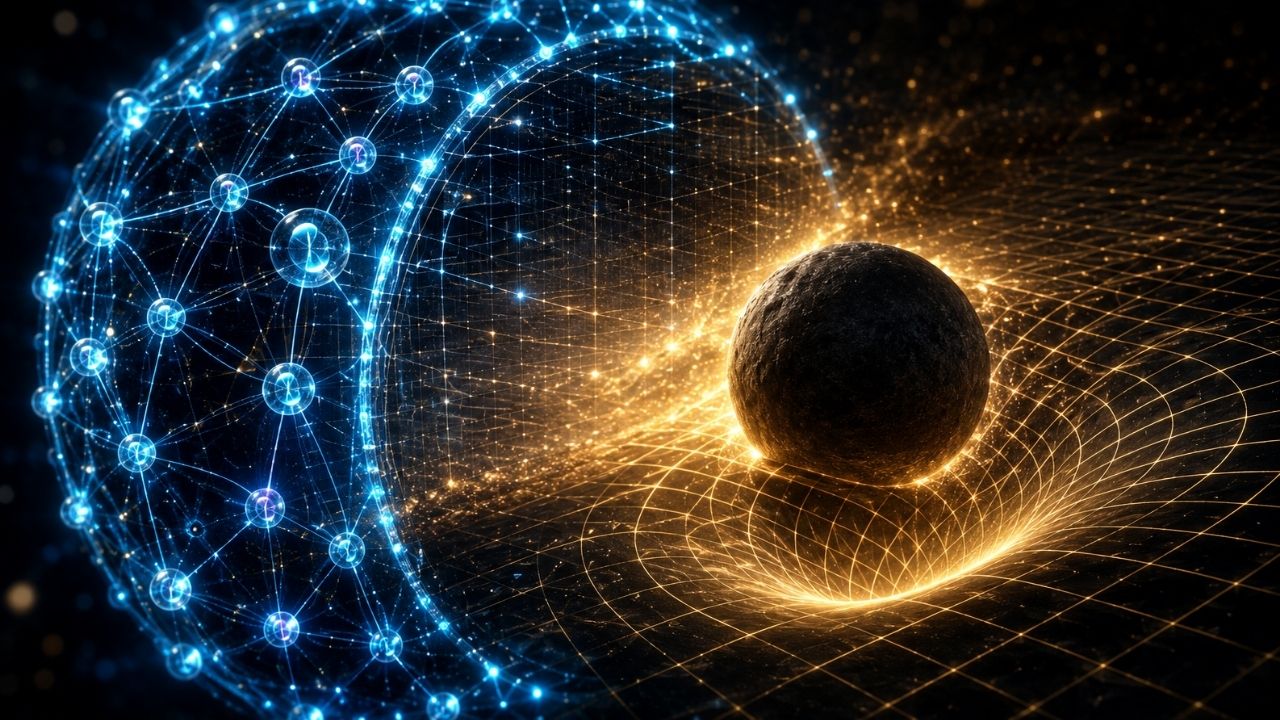
Synopsis
Physicists have learned to encode toy models of space using quantum entanglement and error-correcting codes. But the cleanest early codes had a fatal flaw: their geometry stayed fixed when matter changed, so they could not reproduce gravitational backreaction. This documentary follows holography from black-hole entropy and AdS/CFT through ER=EPR and quantum error correction to 2026 work showing how approximate, magic-enriched codes can make encoded geometry respond to matter. This remains an act
Why This Matters
This story connects three ideas that usually live in different textbooks: gravity, quantum information and quantum computing. It explains why entanglement can help organize emergent geometry, why perfectly protected stabilizer codes leave that geometry inert, and why non-Clifford 'magic' may supply part of the missing matter-geometry coupling. The 2026 results are not a theory of our universe, but they offer a concrete route for studying how gravitational backreaction could emerge from quantum information.
Life & Journey
Bekenstein Links Black Holes and Entropy
Maldacena Proposes AdS/CFT
Ryu-Takayanagi Connects Entanglement and Area
ER=EPR Links Entanglement and Wormholes
HaPPY Holographic Code Introduced
Harlow Develops Holographic Quantum Error Correction
Approximate Bacon-Shor Holographic Code
Magic Explored in Quantum Information and Holography
Magic-Enriched Codes Produce State-Dependent Geometry
Quantum Computer Shows Gravity-Like Holographic Signatures
More from MigOroEdu

Hot Water Can Freeze First. The Reason Is Stranger Than You Think
MigOroEdu · 15 min
The Black Hole Paradox That Threatens Quantum Mechanics
MigOroEdu · 15 min
Alain Aspect
MigOroEdu · 15 min
Lev Landau
MigOroEdu · 15 min