The Scientist Who Made Molecules Visible in Motion
How Joachim Frank reconstructed three-dimensional biological machines from thousands of noisy images.
Joachim Frank transformed structural biology by developing single-particle methods for electron microscopy. After studying physics in Freiburg and Munich and earning his doctorate at the Technical University of Munich in 1970, he pursued ways…
▶ Watch Documentary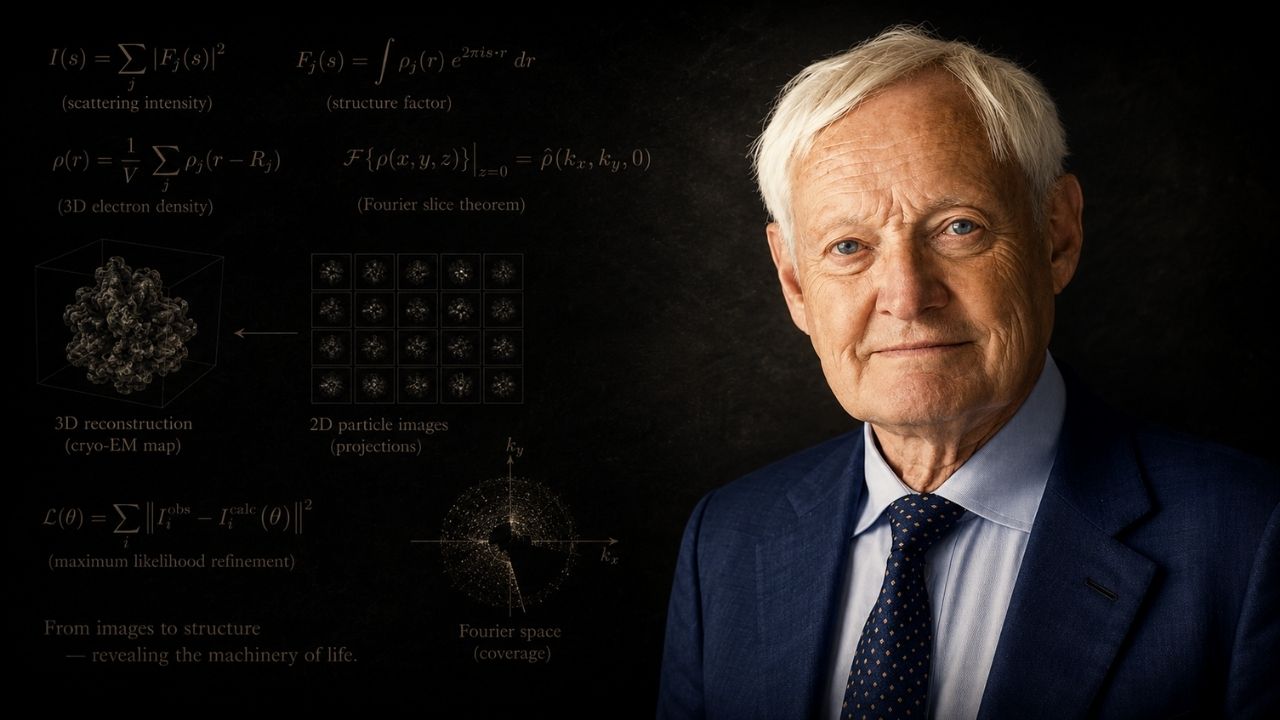
Synopsis
Joachim Frank transformed structural biology by developing single-particle methods for electron microscopy. After studying physics in Freiburg and Munich and earning his doctorate at the Technical University of Munich in 1970, he pursued ways to extract reliable three-dimensional information from extremely noisy molecular images. His techniques revealed ribosomes in different functional states and became central to cryo-electron microscopy. This documentary follows the work that earned a share of the 2017 Nobel Prize.
Why This Matters
Many essential biological machines cannot be crystallized, and traditional imaging once produced only faint, noisy projections. Frank showed that thousands of particle images could be classified, aligned and combined into detailed three-dimensional structures, even capturing different stages of molecular motion. His methods helped turn cryo-EM into a revolutionary tool for medicine and biology. This documentary explains how mathematical image processing opened a new window into life at the molecular scale.
Life & Journey
Born in Siegen
Freiburg Physics Degree
Munich Diploma
Munich Doctorate
Harkness Fellowship
Single-Particle Methods
Joined Wadsworth Center
Howard Hughes Investigator
Joined Columbia
Nobel Prize
More from MigOroEdu
Earth Has a Secret Climate Engineer — And It Isn’t Us
MigOroEdu · 15 min
Luis Caffarelli
MigOroEdu · 15 min
Alain Aspect
MigOroEdu · 15 min
László Lovász
MigOroEdu · 15 min