The Physicist Who Split Reality into Many Worlds
How Hugh Everett removed wave-function collapse and proposed a universe that never stops branching.
Hugh Everett III challenged the foundations of quantum mechanics by proposing that the universal wave function never collapses. Instead, every measurement correlates observers with different outcomes inside a continuously evolving quantum state. Developed at…
▶ Watch Documentary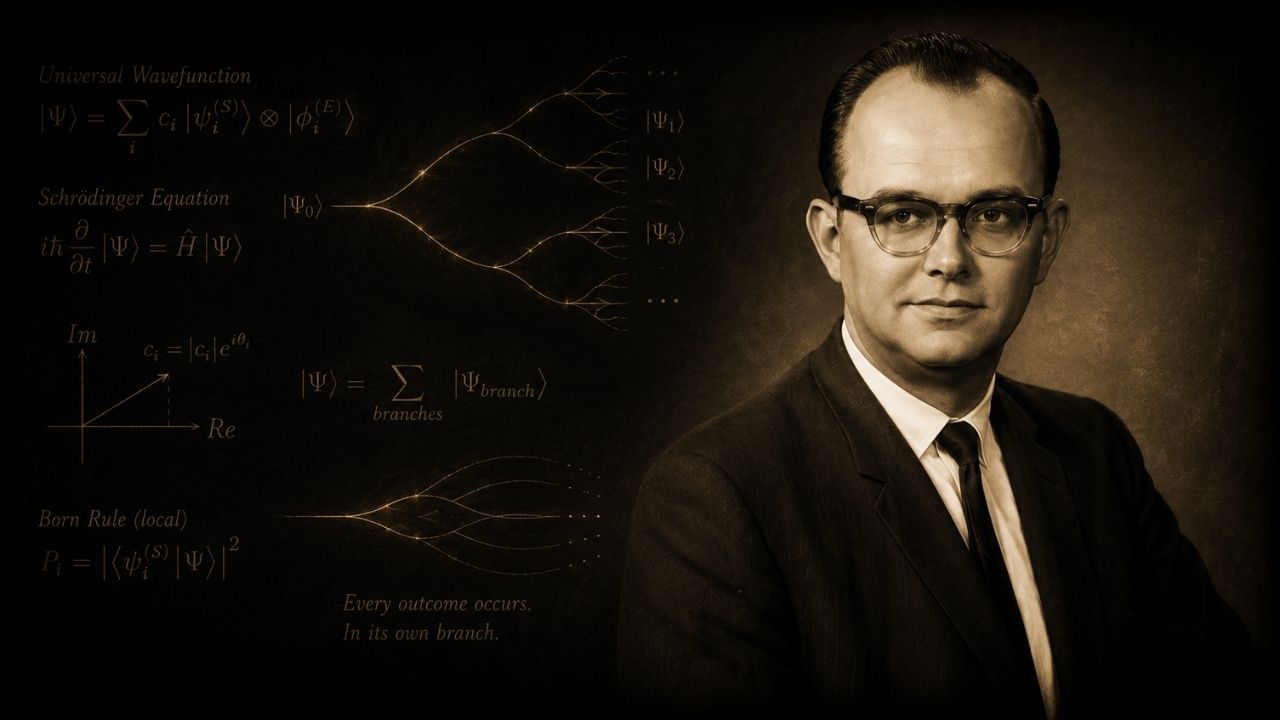
Synopsis
Hugh Everett III challenged the foundations of quantum mechanics by proposing that the universal wave function never collapses. Instead, every measurement correlates observers with different outcomes inside a continuously evolving quantum state. Developed at Princeton under John Wheeler, his 1957 relative-state formulation was later popularized as the many-worlds interpretation. This documentary follows Everett from chemical engineering and game theory to quantum foundations, defense analysis and delayed scientific.
Why This Matters
Everett's theory attacks the quantum measurement problem by refusing to divide reality into a classical observer and a quantum system. Though ignored and resisted during his lifetime, it later influenced decoherence theory, quantum cosmology and discussions of quantum computation. His departure from academic physics makes the story especially striking: an idea once treated as unacceptable survived without its creator's active support. This documentary examines what many worlds really means and why physicists still.
Life & Journey
Born in Washington
Catholic University Degree
Entered Princeton
Princeton Master's
Universal Wavefunction
Joined Defense Analysis
Princeton Doctorate
Relative-State Paper
Many-Worlds Anthology
Death in Virginia
More from MigOroEdu
The Universe That Computed Space — But Forgot Gravity
MigOroEdu · 15 min

The Black Hole Paradox That Threatens Quantum Mechanics
MigOroEdu · 15 min
Luis Caffarelli
MigOroEdu · 15 min
Alain Aspect
MigOroEdu · 15 min