The Mathematician Who Solved the Three-Dimensional Kakeya Problem
How Hong Wang conquered a century-old geometry problem about lines, directions and dimension.
Hong Wang transformed harmonic analysis and geometric measure theory through new methods for understanding how lines and directions occupy space. Educated at Peking University, École Polytechnique, Paris-Saclay and MIT, she developed powerful restriction estimates…
▶ Watch Documentary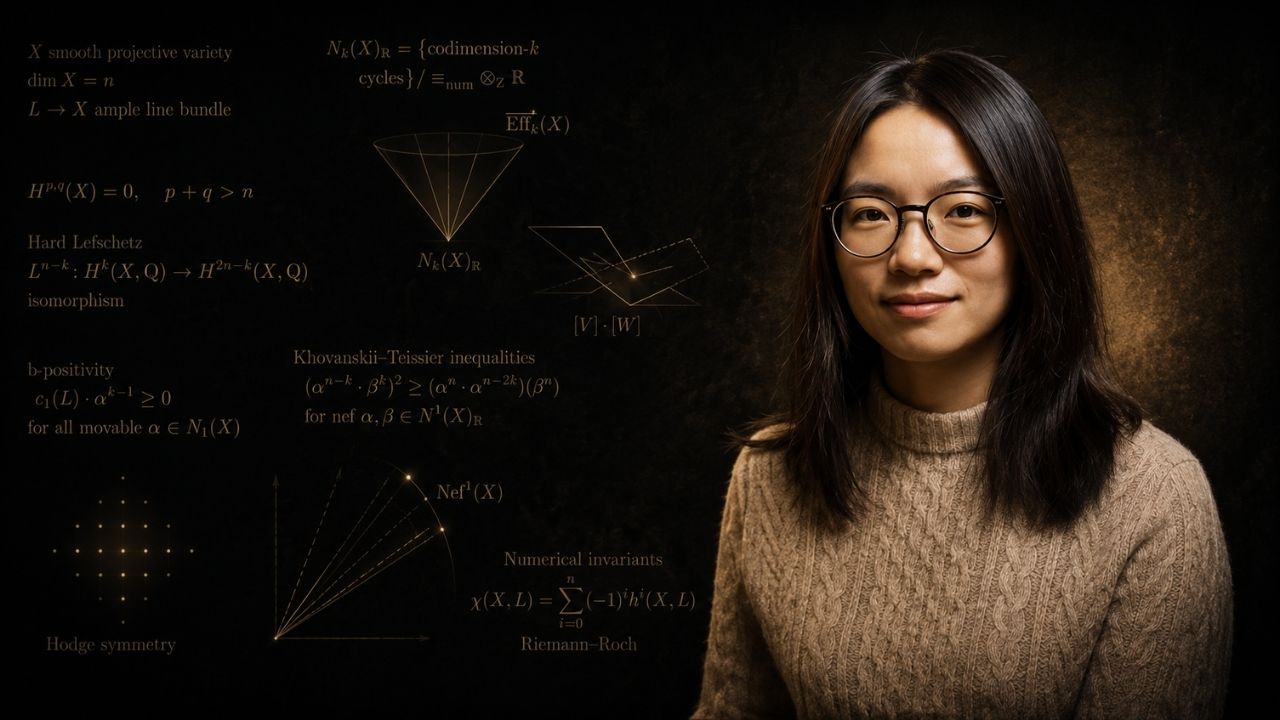
Synopsis
Hong Wang transformed harmonic analysis and geometric measure theory through new methods for understanding how lines and directions occupy space. Educated at Peking University, École Polytechnique, Paris-Saclay and MIT, she developed powerful restriction estimates before joining UCLA, NYU and IHES. In 2025, with Joshua Zahl, she completed a proof of the three-dimensional Kakeya set conjecture. This documentary follows the breakthrough and the research journey that culminated in her 2026 Fields Medal.
Why This Matters
The Kakeya conjecture asks how small a set can be while still containing a unit line segment in every possible direction. Though simple to state, it connects geometry with Fourier analysis, partial differential equations and number theory. Wang's proof with Joshua Zahl settled the three-dimensional case after decades of failed attacks and introduced ideas likely to influence many other problems. This documentary explains the needle puzzle, the hidden mathematics and a historic Fields Medal achievement.
Life & Journey
Born in Guangxi
Entered Peking University
Mathematics Degree
Paris Master's Degree
MIT Doctorate
Joined IAS
Joined UCLA
Joined NYU
Kakeya Conjecture Solved
Fields Medal
More from MigOroEdu
A Problem So Simple a Child Can Understand It — And Nobody Can Solve It
MigOroEdu · 15 min

The Pattern That Was True a Trillion Times — And Still False
MigOroEdu · 15 min

The Shape That Can Fill Space — Without Ever Repeating It
MigOroEdu · 15 min