Can Physicists Catch a Single Particle of Gravity?
A cryogenic detector could register one quantum of gravitational energy, reopening the century-old fight over whether forces come in particles.
Gravitons are hypothetical quantum particles that would make up gravitational waves, but detecting one was long considered impossible. This concept documentary follows the problem from Freeman Dyson’s Earth-sized detector estimate to a 2024 proposal…
▶ Watch Documentary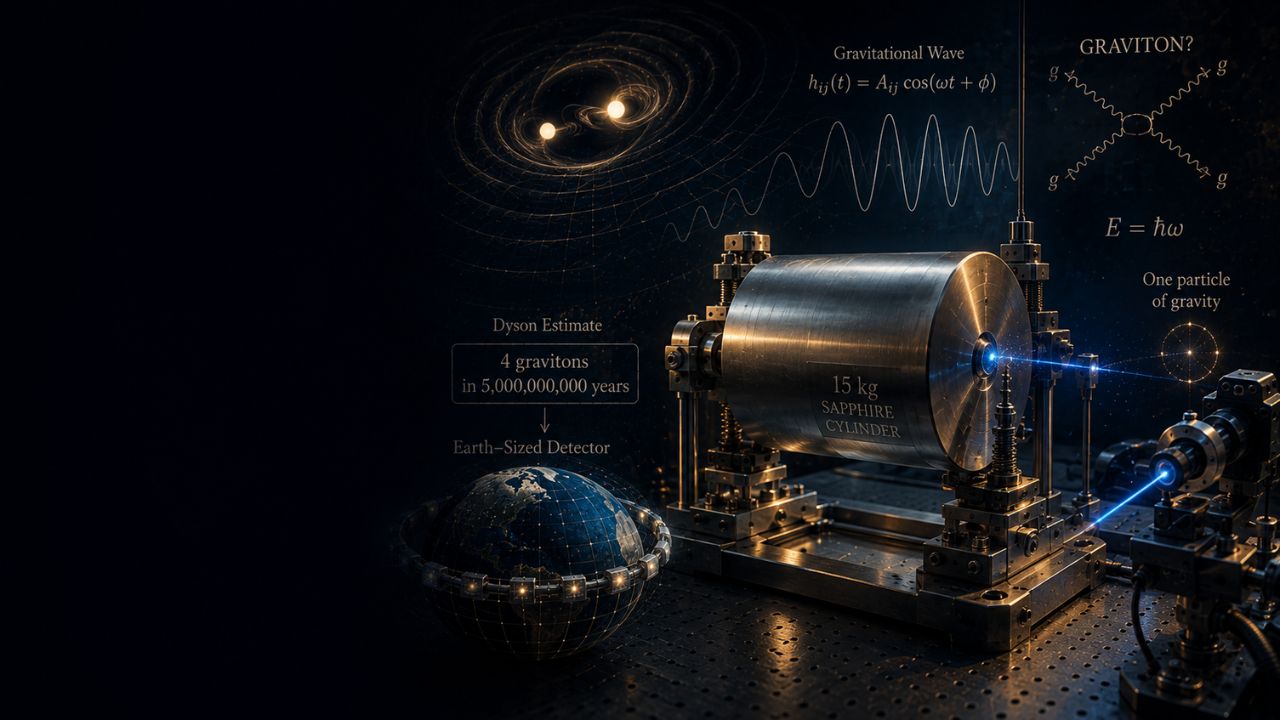
Synopsis
Gravitons are hypothetical quantum particles that would make up gravitational waves, but detecting one was long considered impossible. This concept documentary follows the problem from Freeman Dyson’s Earth-sized detector estimate to a 2024 proposal using a fifteen-kilogram beryllium bar cooled close to absolute zero. A known gravitational wave could make the resonator absorb one quantum of energy and ring. The catch is that a classical gravitational wave might still imitate the same result. a d
Why This Matters
LIGO detected gravitational waves, not gravitons. That distinction exposes one of physics' deepest conflicts: quantum theory describes nature in discrete units, while general relativity treats spacetime as smooth. The proposed resonant-bar experiment could make a once-impossible measurement realistic, but it also recreates the loophole that complicated early photon experiments. This video explains the detector, the logic behind it and why proving gravity is quantum requires more than observing one dramatic click.
Life & Journey
Light Quanta Proposed
General Relativity Published
Einstein Nobel Awarded
Photon Opposition Fades
Photon Antibunching Demonstrated
Dyson Detection Estimate
Gravitational Waves Detected
Massive Quantum State
Single-Graviton Proposal
Semiclassical Loophole
More from MigOroEdu
Hot Water Can Freeze First. The Reason Is Stranger Than You Think
MigOroEdu · 15 min
The Universe That Computed Space — But Forgot Gravity
MigOroEdu · 15 min
The Black Hole Paradox That Threatens Quantum Mechanics
MigOroEdu · 15 min
Luis Caffarelli
MigOroEdu · 15 min