The Physicist Who Unified Rival Quantum Theories
How Freeman Dyson connected Feynman and Schwinger, then imagined technologies far beyond his time.
Freeman Dyson transformed postwar physics by proving that Feynman’s diagrammatic approach to quantum electrodynamics was equivalent to the formulations of Schwinger and Tomonaga. Born in England in 1923, he worked in RAF operational research,…
▶ Watch Documentary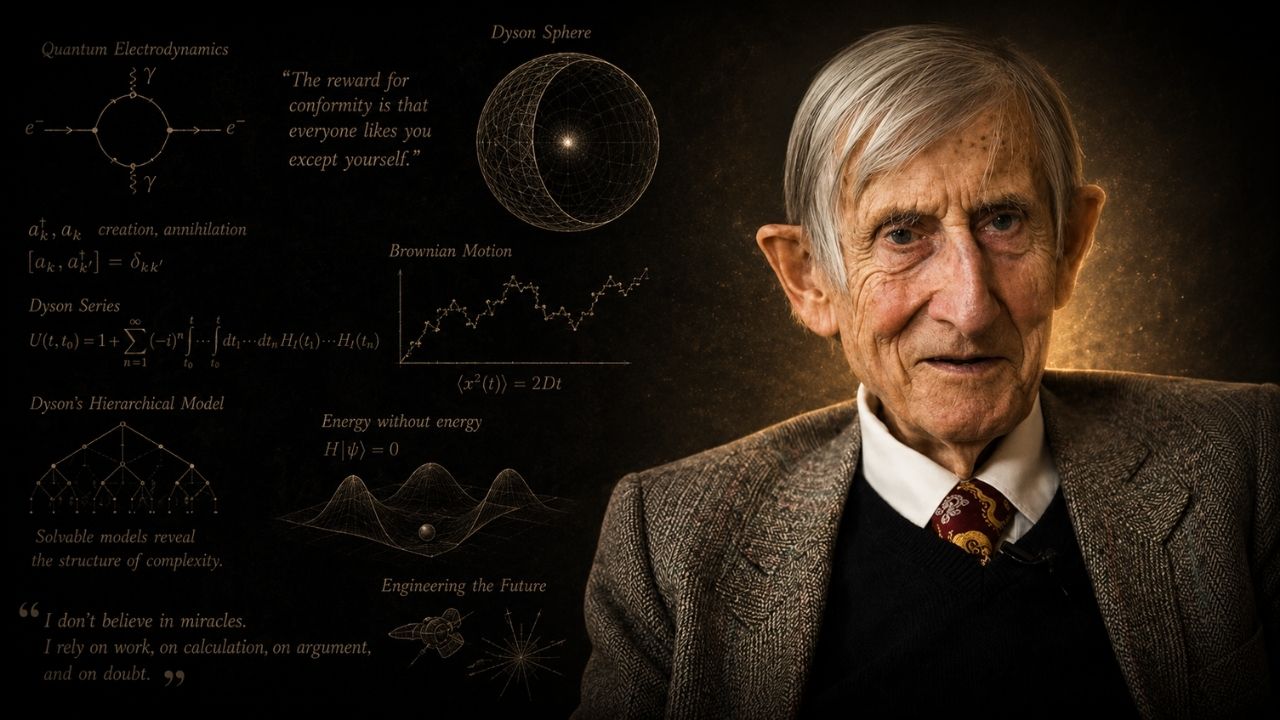
Synopsis
Freeman Dyson transformed postwar physics by proving that Feynman’s diagrammatic approach to quantum electrodynamics was equivalent to the formulations of Schwinger and Tomonaga. Born in England in 1923, he worked in RAF operational research, graduated from Cambridge and moved to Cornell and the Institute for Advanced Study. He later ranged across nuclear engineering, condensed matter, random matrices, space travel and speculative biology. This documentary follows a mind that refused to remain inside one field.
Why This Matters
Dyson's QED papers helped turn competing methods into a coherent theory and made modern particle calculations practical. Yet his influence extended far beyond one breakthrough: he helped prove the stability of matter, shaped reactor design and proposed audacious futures involving nuclear spacecraft and energy-harvesting civilizations. His career raises a compelling question about scientific imagination: how far should rigorous knowledge be allowed to travel into speculation? This documentary explores both the power and.
Life & Journey
Born in England
Joined RAF Research
Cambridge Degree
Moved to Cornell
Unified QED Methods
Cornell Professor
Joined IAS
Heineman Prize
Wolf Prize
Death in Princeton
More from MigOroEdu

Hot Water Can Freeze First. The Reason Is Stranger Than You Think
MigOroEdu · 15 min
The Universe That Computed Space — But Forgot Gravity
MigOroEdu · 15 min
The Black Hole Paradox That Threatens Quantum Mechanics
MigOroEdu · 15 min
Luis Caffarelli
MigOroEdu · 15 min