The Woman Who Taught Computers How to Survive Failure
How Margaret Hamilton's software engineering made one of history's greatest achievements possible.
Margaret Hamilton led the Software Engineering Division at MIT Instrumentation Laboratory, where her team developed the onboard software that guided Apollo missions to the Moon. Her groundbreaking concepts of priority scheduling, asynchronous processing and…
▶ Watch Documentary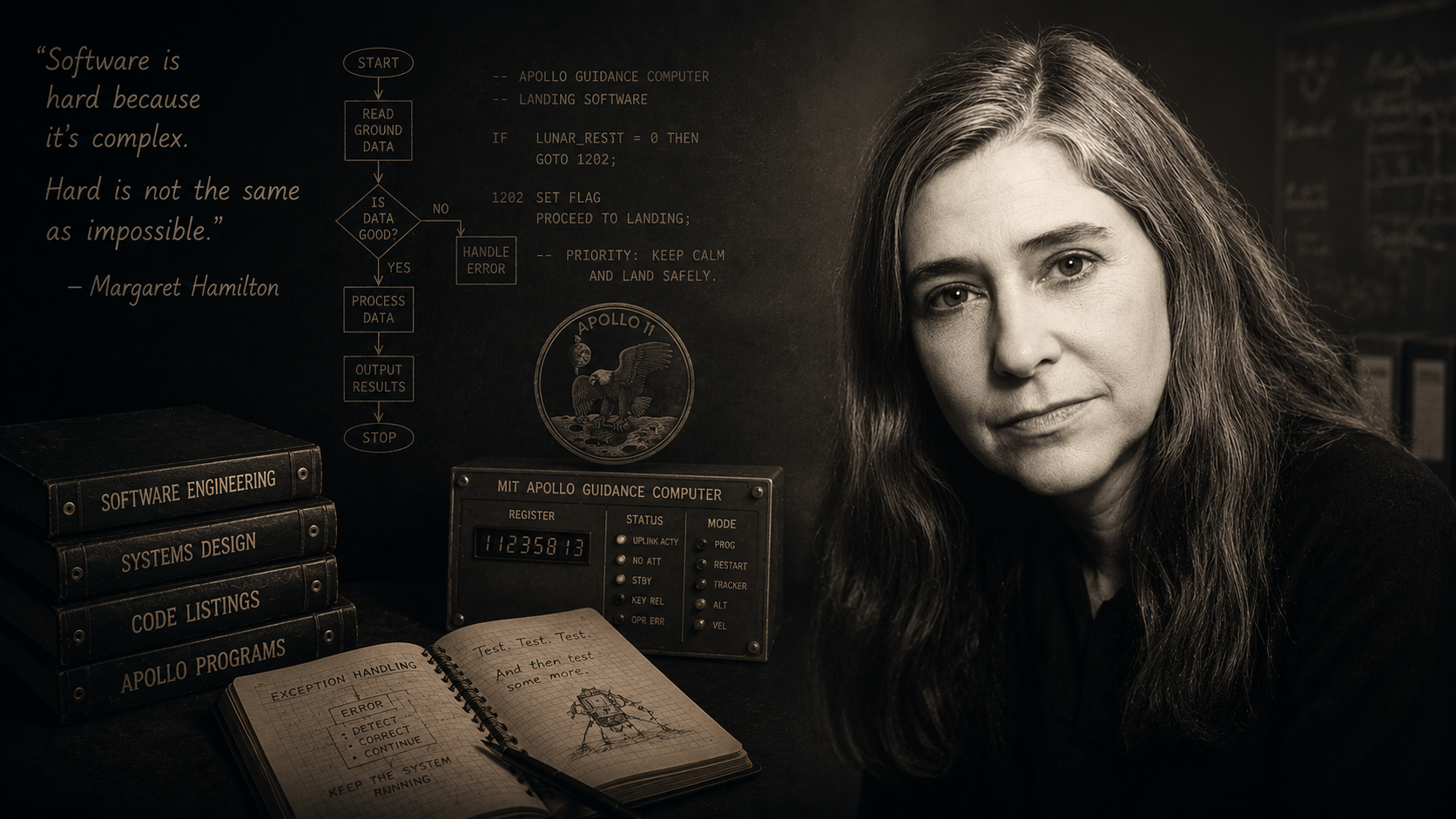
Synopsis
Margaret Hamilton led the Software Engineering Division at MIT Instrumentation Laboratory, where her team developed the onboard software that guided Apollo missions to the Moon. Her groundbreaking concepts of priority scheduling, asynchronous processing and fault-tolerant software allowed Apollo 11 to recover from unexpected computer overloads during its final descent. By proving that software could be engineered with the same rigor as hardware, she laid the foundation for the reliable computer systems that power countless technologies today.
Why This Matters
Modern society depends on software making life-critical decisions every second, from aircraft navigation to medical devices and autonomous systems. Margaret Hamilton demonstrated that software must anticipate failure rather than simply execute instructions. Her pioneering engineering principles continue to influence mission-critical computing around the world, while her career helped establish software engineering as one of the most important disciplines of the digital age.
Life & Journey
Born in Indiana
Earlham Graduate
MIT Programming
SAGE Project
Apollo Software
Moon Landing
Software Company
Hamilton Technologies
NASA Award
Freedom Medal
Key Takeaways
Margaret Hamilton leads the MIT team that develops Apollo's onboard flight software for the historic Moon missions.Her priority-based software allows Apollo 11 to survive computer overloads during the final lunar landing.She pioneers software engineering practices that become the foundation of today's mission-critical computer systems.
More from MigOroEdu
Luis Caffarelli
MigOroEdu · 15 min
Alain Aspect
MigOroEdu · 15 min
László Lovász
MigOroEdu · 15 min

John Pardon
MigOroEdu · 15 min